Friday, August 17, 2018

Stylishly Late: Late Summer Movie Season Entries that Helped Make the Dog Days Just a Little Cooler


By Michael Lyons


As store shelves become crowded with notebooks, schools re-open and the words “Pumpkin Spice” resurface, there’s no denying the fact that another summer is coming to a close.

As the sun sets on the season filled with the endless promise of vacation, crowded beaches and nice weather, we also bid farewell to the Sumer Movie Season, Hollywood’s popcorn fueled months of sequels, super heroes, dinosaurs, animation, explosions and a large amount of guaranteed box-office.

Don’t mark the Summer Movie Season out for the count just yet, with still a few weeks to go, the movie industry could pull out one more “win” before we head into Labor Day.  In fact, some Summer Movie Seasons past have included movies that were critically acclaimed and/or box-office successes during the waning days of August.

As we hurtle headlong to Summer’s end like the last wave crashing on a beach, it’s the perfect time to look at these late season entries from Summers past.


“Married to the Mob” (1988)

From the always unique vision of Director Jonathan Demme, this original comedy snuck into theaters in late summer thirty years ago.  In it, Michelle Pfeiffer plays Angela DeMarco, a mafia wife, who tries to escape “the life,” after her husband is murdered.  In the process, she finds herself falling in love with an FBI Agent and pursued by the mafia kingpin who put the hit on her husband.

As he did with all of his films, the late, great Demme jam-packs “Married to the Mob” with colorful characters, who generate the film’s laughs.  Pfieffer does a spot-on “New Yawk” accent and the always solid Matthew Modine is charming as the squeaky-clean FBI agent she falls for.

Stealing the show is Dean Stockwell, as mob boss Tony “the Tiger,” a ruthlessly funny performance that earned the actor a Best Supporting Actor Oscar Nomination.  A close second to walking away with the film is Mercedes Ruehl, in her first major role, as Tony’s hot tempered wife, Connie.

They all come together in a movie about murder and infidelity, that’s somehow uniquely it’s own thing.  “Married to the Mob” is a light, breezy, screwball comedy...that packs heat.


“Needful Things” (1993)

This adaptation of Stephen King’s wickedly devilish novel is a horror movie with a smirk on its face.

Set in King’s often used fictional small town of Castle Rock, Maine, “Needful Things” tells the story of a mysterious shop owner (the always amazing Max Von Sydow), who opens up an antique store, that just happens to have what each resident of the town desires.  He agrees to sell to them, if they grant him certain “favors,” which wind up turning the residents against each other.

Directed by Fraser Heston (Charlton’s son) with a cast that includes Ed Harris, Bonnie Bedelia, J.T. Walsh and Amanda Plummer, “Needful Things” captures all of the horrific tension from King’s novel, along with a theme about how our desire for material things can drive us to madness...which, ironically, seems even more relevant twenty-five years after this movie’s late summer debut.


“Blade” (1998)

Two decades ago, before comic book movies became a staple of early summer, this adaptation of a Marvel comic bowed in late August.  In it, Wesley Snipes is a half-vampire/half-human, who has sworn to rid the world of vampire evil and avenge his mother’s death.

Developing quite the following that generated two sequels, “Blade” served as the title character’s origin story.  Directed in stylish extremes by Steven Norrington, this film has found itself lost in the avalanche of super hero films that have followed two decdaes later.

But while there are many others, “Blade” still finds itself surfacing during fan discussions of favorite comic book movies,


“Tropic Thunder” (2008)

One of the most original comedies in recent years, with an ingenious, satirical story seemed like a height of summer blockbuster, but bowed in late August.

In the film, three vain actors: an action star (Ben Stiller) looking to change his image, an almost washed up comedian (Jack Black) yearning to be taken seriously and an over-the-top method actor (Robert Downey, Jr.) find themselves lost in a hostile, third-world jungle while filming a movie about the Vietnam War.

The entire Cast of “Tropic Thunder” is, literally firing on all cylinders in a smartly crafted film (directed by Stiller) that delivers crowd-pleasing laughs throughout, while gleefully not caring that it’s biting the film industry hand that’s feeding it.

In one of film’s most daring performances, Robert Downey Jr’s is hysterically jaw dropping, as he plays Kirk Lazarus, an Australian actor who undergoes a procedure to darken his skin so he can play a black character.  He completely disappears into the character and rightfully earned himself a Best Supporting Actor Oscar Nomination.

Rounding out the Cast is Nick Nolte, Matthew McConaughey, Jay Baruchel, Steve Coogan, Bill Hader, Danny McBride and Tom Cruise (yup, Tom Cruise!) in a gonzo comedic performance as a brutal, mean-spirited studio executive.

From the film’s opening “trailers” to its end credit rap dancing, “Tropic Thunder” is the rare comedy that earns more appreciation and laughs even a decade after its debut.


These films, like a surprise, perfect weather day, helped make summer last just a little longer.

Sources:
IMDb
Wikipedia

Friday, August 10, 2018

Caught up the “Wake” of “Jaws”: Pre-“Meg” Movies that were inspired by Spielberg’s Seminal Summer Blockbuster


By Michael Lyons

They say that imitation is the sincerest form of flattery.  If that’s the case, then Hollywood is a VERY flattering place.

This was especially true in the mid-to-late ‘70’s, when every Studio was trying to replicate the success of the world’s first Summer Blockbuster, “Jaws.”  What followed was a series of not-as-thrilling movies in which an animal/force of nature launches an attack.

One of the decendants of this trend, “The Meg,” hits theaters this weekend.  The film, based on the best selling book by Steve Alten, is about a giant, prehistoric shark seemingly swimming out of the past and into our world.

There’s no better way to commemorate this latest Hollywood “attack,” by looking back at the “Jaws clones” that rampaged through theaters, after Steven Spielberg’s landmark film debuted in 1975.


“Grizzly” (1976)

This movie may seem like a low-budget B movie that was made quickly and released one year after “Jaws,” to cash in on that movie’s success...actually...it doesn’t seem that way...that’s exactly what it is.

Substituting a grizzly bear for a shark and a national park for Amity Island, this film unabashedly carbon copies the “Jaws” model.  However, this tale of a killer grizzly attacking campers lacks the suspense and ingenuity that made Spielberg’s film an unforgettable masterpiece.

What “Grizzly” does have is a parade of recognizable character actors of the time, such as Christopher George and Richard Jaeckel and also boasts one of the most Drive-In Movie worthy posters of the decade!


“The Deep” (1977)

Another movie that rode the “coatfins” of “Jaws,” this one at least did so with an original plot.  In “The Deep,” a young couple (Nick Nolte and Jacqueline Bisset) uncover artifacts while diving through a shipwreck, off the coast of Bermuda and wind up getting caught up with local, drug dealing criminals.

With an underwater setting, based on a book by “Jaws” author Peter Benchley and co-starring Quint himself, Robert Shaw,“The Deep” is definitely doing all it can to reach audiences who were eager for a “Jaws fix.”

However, today the movie is more remembered for Jacqueline Bisset’s now famous wet T-shirt scene and less for its action sequences involving a giant eel. 


“Piranha” (1978)

This movie should be next to the definition of the phrase “Cult Movie.”  Produced by B-Movie maestro Roger Corman and directed by Joe Dante (who would go on to helm blockbusters like “Gremlins”), “Piranha” unabashedly copied “Jaws,” but has also emerged as something all it’s own, with a following that has grown through the years.

“Piranha” is about the nasty-looking, flesh eating titular fish, who are accidentally dumped into the water at a resort...and it’s meal time!

With a surprisingly clever script penned by John Sayles (who would go on to have a very distinguished, Oscar nominated film career) and a cast of veteran actors, including Keenan Wynn and Kevin McCarthy, “Piranha” is an unabashed, all-out horror gorefest.  In fact, “Piranha” has such a devoted following that it was re-made (loosely) in 2010...in 3D, no less.


“The Swarm” (1978)

“Jaws” meets a disaster movie.  That’s probably how this movie was pitched.  This makes sense seeing that “The Swarm” is from director Irwin Allen, the disaster movie maestro behind such films as “The Poseidon Adventure” and “The Towering inferno.”

In this outing, the country is under attack by a massive swarm of killer bees, which includes the usual large scale mayhem, including scenes in which the bees cause helicopters to crash and a train to derail.

While the nature on attack angle owes a lot to “Jaws,” the rest of the film looks and feels like a full on disaster movie, from it’s all-star cast (Michael Caine, Katherine Ross, Olivia de Havilland, Richard Chamberlain, Fred MacMurray and Henry Fonda) to its conclusion in which an entire city is torched in order to kill the bees.

Made at the tail end of the disaster movie craze, “The Swarm” almost seems like a parody of itself at times, but movie fans of a time gone by will no doubt find it still has some...sting.


So, as “The Meg” splashes across screens this weekend, it may feel overwhelmed by the shadow of the Great White Shark that first captivated audiences 43 summers ago.  However, the film can take comfort in the fact that there have been plenty of other movies who have also wanted to take a bite out of the “Jaws” box office.

Sources:
IMDb
Wikipedia

Saturday, August 4, 2018

“A Long Time Ago...”: The 45th Anniversary of “American Graffiti”


By Michael Lyons

All of the nostalgia, the “retro,” the “throwbacks,” the “looking back,” the “fondly remembering” that goes on today can actually be traced back 45 summers ago, when “American Graffiti” debuted.

George Lucas’ love letter to a simpler time: the late ‘50’s and early ‘60’s, during the era of drag racing, cruising, ducktailed “hoods,” malt shops and the early years of rock and roll, connected with the generation who (in the ‘70’s) had come of age during that time.

“American Graffiti” had an almost immediate response from audiences when it was released and helped launch the career of one of Hollywood’s most influential directors.

With the film that asked the poetic question “Where Were You in ‘62?” Celebrating its 45th anniversary, it’s the perfect time to take trip back in time to revisit the film.

With a very simple plot that involves weaving a number of stories together, “American Graffiti” takes place on the last night of summer vacation and follows several friends through a number of misadventures.

There’s Curt (Richard Dreyfuss), a straight laced high school graduate, about to head off to college, who becomes obsessed with finding a beautiful blonde girl (Suzanne Somers) he spotted in a car and winds up getting mixed up with a group of “greasers;” High school sweethearts Steve and Laurie (Ron Howard and Cindy Williams) who argue and make-up throughout the evening; John (Paul LeMat) an avid drag racer who winds up squaring off in a race with a loud mouth named Bob (Harrison Ford) and Terry “Toad” (Charles Martin Smith) the “nerd’ who is thrilled to have date with Debbie (Candy Clark).

The Cast of “American Graffiti” now plays like a “Who’s Who” directory of Hollywood, but at the time, the Cast (with the exception of Howard) were relative unknowns and this turned out to be their big break.  This was also a big break for director Lucas.  After the success of this film (produced by his friend Francis Ford Coppola), Lucas gained some clout, which allowed him to begin work on his true passion project about a “Galaxy Far, Far Away.”

Part of the success of “American Graffiti” was its ability to create such a believable “time and place,” bringing a past era alive as never before.  This happens immediately in the opening credits, in which “Rock Around the Clock” by Bill Haley and the Comets bounces across the soundtrack.  In fact, the film has a wall-to-wall pop and rock music soundtrack that set the standard for films to come. 

Then, there’s the iconic image of “Mel’s Drive-in” malt shop, the sweeping fins of the cars of the time and even the language itself (“You want a knuckle sandwich?”), “American Graffiti” became the first film to use pieces of our past pop culture as a setting for a film.

Released on August 11, 1973, “American Graffiti” was not only a hit, but it sparked a wave of obsessive nostalgia around the late ‘50’s and early ’60’s..  Movies like “The Lords of Flatbush”  and “Grease” followed; ‘50’s tribute bands like “Sha-Na-Na” become immensely popular and, of course, on TV, “Happy Days” and “Laverne and Shirley “(which continued the soaring trajectory of Ron Howard’s and Cindy Williams’ careers) became two of the most popular shows of the decade.

The generation that had come of age during the time of “American Graffiti” were hungry to re-live that time, with a film and story that not only re-captures it, but also, in a melancholy way, shows audiences a time of innocence, before everything was turned upside down by the tumultuous late ‘60’s and early ‘70’s.

And now 45 years later, we can all be nostalgic for one of the world’s most nostalgic films, “American Graffiti.”


Sources:
IMDb
Wikipedia


Friday, July 27, 2018

Summer “Cel”-ebration!: Classic Cartoons on Summer Vacation


By Michael Lyons

It’s the Dog Days of Summer.  It’s also the Cat Days, Mouse Days, Duck Days and even Popeye Days of summer!

As we find ourselves in the midst of this hot, hazy and humid season of bar-b-ques, summer camps, beaches and vacations, a great way to mark all that summer has to offer is to turn back the clock to a time when cartoon short subjects were part of a night at the movie theater.

In the Golden Age of Hollywood Studio animation, cartoon characters who were stars of these shorts, found themselves in a variety of seasons and settings, including summer.

Watching these summer-themed cartoons, in all of their 2-D, traditional animation glory, there’s not just a sense of innocence for a time gone by, but of all the glory that the season of summer holds.


Hawaiian Holiday (Disney, 1937)

A very iconic cartoon short from Disney that stars the Studio’s “Fab Five:”  Mickey Mouse, Minnie Mouse, Donald Duck, Goofy & Pluto, all together on vacation in Hawaii.

Directed by Studio veteran Ben Sharpsteen, the short has lush background design, as well as great animation of the characters at their most classically iconic.  It also features brilliant sight gags, such as Goofy battling a wave while surfing and getting “flung” to shore and Pluto fighting with a crab, with some painful results.

All of “Hawaiian Holiday” is SO classically Disney, from look to design to music that the short is as warm, comfortable and welcoming as vacation itself.

  
Vacation with Play (Famous Studios, 1951)

Popeye the Sailor and his girlfriend Olive Oyl embark on a resort vacation.  Popeye wants to relax and sleep, while Olive wants to take part in some of the resort’s activities.

Soon, Olive finds herself pursued by the Resort’s Activity Director, played by, you guessed it, Bluto.  Popeye is soon iterally battling Bluto for Olive’s affections.  After downing a can of Spinach and fighting to “the finach,” Popeye defeats Bluto and wins Olive back.

Not as strong as many short subjects of the time, “Vacation with Play” features some amped up “cartoon violence,” when Popeye and Bluto go at it (Popeye is literally knocked out and sent flying back into his hammock).

Still all the now iconic trademarks of a Popeye short are there, coupled with a cartoon glimpse of what resort vacationing looked like about 60 years ago.  It’s a quaint, nostalgic look at summers past.


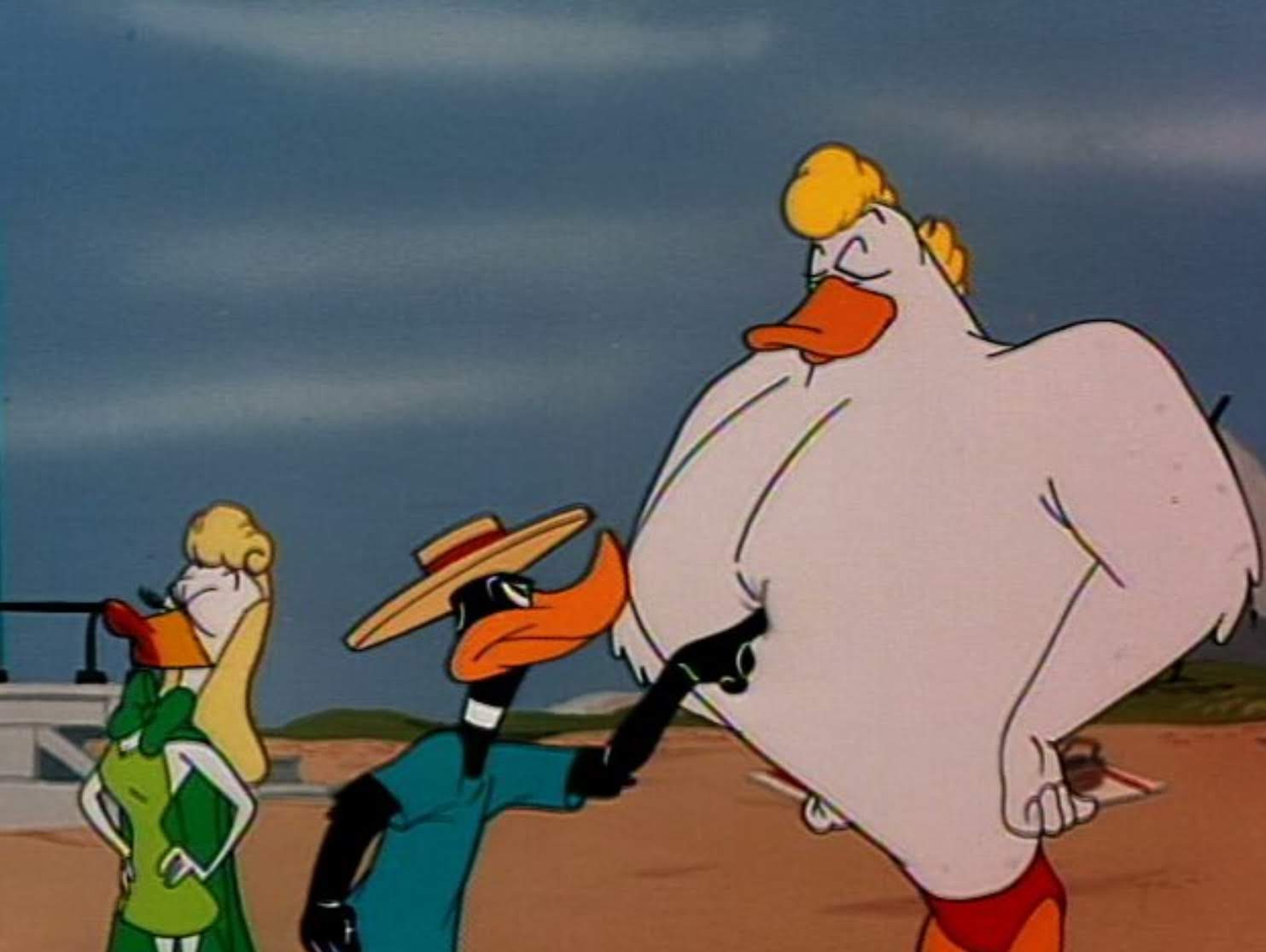
Muscle Tussle (Warner Bros., 1953)

Daffy Duck takes his girlfriend to the beach, only to have words with a musclebound duck.  Daffy wises off to the mammoth mallard, who tells Daffy that he will knock his “head so far down between your little old shoulders, you’ll have to unbutton your vest to eat!”

Daffy proceeds to get pummeled and his girl leaves with the muscular duck.  Daffy then attempts to win his girlfriend back by purchasing a questionable muscle tonic...which has disastrous and funny results.

Warner Bros. Animation legend Robert McKimson brings his ingenious, quiet comedic style to this short.  When Daffy’s girlfriend calls him a 9-lb weakling, Daffy retorts, “How do you like that?  Calling me a scrawny little 9-lb weakling, when it’s perfectly obvious I’m a scrawny little 10-lb weakling!”

There’s also fun character design, particularly in the ridiculous looking bodybuilding bully of a duck.

As with many Warner Bros. Shorts, this one also skewers popular culture, as it seems to be poking fun at ads at the time promoting “Charles Atlas body building books,” which included a comic strip featuring a skinny “wimp,” at the beach getting sand kicked in his face.  Obviously, one of the many summer dangers of the time! 


Barbeque Brawl (MGM, 1956)

One of MGM’s Studio’s wide screen Cinemascope cartoons, this Tom and Jerry offering centers on the bulldog father and son Spike and Tyke, who are settling in for a backyard barbecue, when they are interrupted by the cat and mouse chasing antics of Tom & Jerry.

What follows is what one would expect with Jerry outsmarting Tom and Tom getting in the way of Spike and Tyke’s barbecue (to Spike’s fury).

What sets this cartoon apart is how stylized the backgrounds are, obviously influenced by both the UPA Studio and television animation, that was on the rise in the ‘50’s.  The imperfect, crooked lines and colors, so prevalent in animation at the time, adds a note of nostalgia to the proceedings.

Also, it’s nice to reflect back on a time when charcoal briquettes were a part of barbecuing and an army of ants was a mainstay of any cartoon picnic.


All of these cartoon shorts are a nice reminder of a time when animation was a prevalent part of major Hollywood Studios and the regular moviegoing experience.

That silver screen era has faded like the last days of summer itself.  However, thanks to the filmmakers who brought us these shorts, we can celebrate summer with our favorite cartoon stars and enjoy all that the sunshine season brings our way.


Sources:
Boomerang
IMDb
Wikipedia 


Thursday, July 12, 2018

“A Quest for Fun!”: The 35th Anniversary of “National Lampoon’s Vacation”


By Michael Lyons

It’s tough to pick a favorite scene.

That’s the type of movie “National Lampoon’s Vacation” has become.  The trials and tribulations of the Griswold family’s cross country trek to spend summer vacation at “America’s Favorite Family Fun Park, ” Wally World has become the stuff of hysterical legend.

This summer, “National Lampoon’s Vacation” marks its 35th anniversary, which means there’s no better time to hop in the ol’ Family Truckster and travel back in time to celebrate this ever re-watchable comedy classic. 

One of the first major scripts by John Hughes, (who had based the screenplay on his short story, “Vacation ‘58,” which had appeared in “National Lampoon” magazine), “National Lampoon’s Vacation” contained all the hallmarks of the filmmaker’s later films: broad comedy that shines an oh-so-realistic light on society. 

In it, Clark Griswold (Chevy Chase) becomes obsessively focused with taking his wife Ellen (Beverly D’Angelo) and kids Audrey and Rusty (Dana Barron and Anthony Michael Hall) to Wally World Theme Park, home of Marty Moose (an obvious and clever sting at Disney).  

Of course, nothing goes as planned and everything goes wrong, which results in some of the funniest and most memorable scenes the comedy movie world has ever seen.

Pulling all of this together with perfect staging and pacing is director Harold Ramis, who had only made one film (“Caddyshack”) prior to “National Lampoon’s Vacation.”  With this film, Ramis’ trademark ability to solidly stage a comic film that sustains laughs throughout its entire running time is on display.

Bringing it all to life like a solid rep company is the cast: Chase, is at the zenith of his stumbling comic timing and D’Angelo as his put upon wife believably delivers her straight lines.

In supporting roles, TV comic legend Imogene Coca is all over-the-top crustiness as Aunt Edna; Randy Quaid populates the hillbilly-like Cousin Eddie so well, he doesn’t seem like he’s acting; John Candy is his likable self as the simpleton, officious Wally World Security Guard; Veteran Eddie Bracken is the perfect Walt Disney-like Company figure head, Roy Wally; Christie Brinkley (in her only acting role) is as stunning as her magazine covers of the time and Eugene Levy is shmoozy goodness as the quintessential slime ball car salesman.

The characters and story were so popular that they gave rise to three sequels (another of which, “National Lampoon’s Christmas Vacation” has become an equal classic to the original), as well as a re-boot in 2015.

But, it’s “National Lampoon’s Vacation” that blazed the trail.  Released on July 29, 1983, the film celebrates 35 years this summer.  Three and a half decades of laughing its way into our pop culture psyche (the term “Griswold family vacation” has taken on new meaning).

And, then...there’s those scenes: the Griswolds singing the “Marty Moose Theme Song,” as they drive the open road; Clark falling asleep at the wheel; a Hamburger Helper picnic (without hamburger) at Cousin Eddie’s House; Clark accidentally jumping the Family Truckster like a stunt man; Aunt Edna’s poor dog, dinky’s sad fate; Aunt Edna’s sad fate; Clark swimming with Christie Brinkley (“This is Crazy!  This is Crazy!”); Clark’s “off-the rails” rant at his family; Wally World is closed (“Moose outside should have told you.”).

It’s tough to pick a favorite scene.


Sources:
IMDb

Wikipedia

Friday, July 6, 2018

Saturday “Super” Stars: Cartoon’s Offbeat Heroes


By Michael Lyons

Who would have thought that someday we would get ONE “Ant Man” movie, let alone TWO!  But, here we are, this weekend as Marvel’s latest “Ant Man and The Wasp” hits theaters.

The sequel features a super hero with most unlikely powers.  No iron suit, shield, strength or gift of flight.  Ant Man’s super power is that of making himself small (and sometimes big).

He’s proof that heroes can come in all shapes and sizes and can also come from the most unlikely of places.

Ant Man is also part of a long line of offbeat super heroes that were once a staple of Saturday Morning Cartoons.  With “Ant Man and The Wasp” now poised to do “big” things at the box-office this weekend, it’s the perfect time to look back and celebrate the weird (and wacky) cartoon superheroes of yesteryear. 


“Mighty Mouse” (CBS, 1955)

“Mr. Trouble never hangs around, when he hears this mighty sound: ‘Here I come to save the day!’  That means that Mighty Mouse is on the way!”

So began the theme song to “The Mighty Mouse Show” on Saturday Mornings, letting all know that the diminutive caped rodent was about to take on the bad guy (or, in this case, bad cat).

Created by the Terrytoon Studio in 1942, Mighty Mouse has flown high for years and was re-imagined by the Filmation Studio in the ‘70’s and animator Ralph Bakshi in the ‘80’s.

Originally named “Super Mouse,” as a parody of Superman, Mighty Mouse has become as iconic as the Caped Crusader.


“Space Ghost” (CBS, 1966)

Another iconic Saturday morning cartoon super hero, Hanna-Barbera’s Space Ghost was just that: a super hero who had the ability to fly and make himself invisible, while fighting villains in outer space.

The show was created by Alex Toth, a noted comic book artist who brought the sensibility and style of a comic book to Hanna Barbera.  The visuals, coupled with the booming voice of Gary Owens, created a true sense of those panels on the page coming to life.

If you only know Space Ghost from the ‘90’s comedic re-boot “Space Ghost: Coast to Coast” on Cartoon Network, you owe it to yourself to check out the heroic original.


“Frankenstein Jr. and The Impossibles” (CBS, 1966)

Another “super oddity” from Hanna Barbera.  This show was divided into two separate sections: one involved a young boy scientist named Buzz Conroy who fought crime with the aide of his robot, Frankenstein, Jr.; the other part of the show focused on The Impossibles, a trio of super heroes.  They were Multi-Man (the power of duplication), Coil Man (spring action!) and Fluid Man (can easily turn himself to water).  Oh, and The Impossibles was also a rock band.

Was the show as weird as it sounds?  Sure was.  Is it as fun as it sounds?  Sure is.


“The Mighty Heroes” (CBS, 1966)

Ralph Bakshi, who would not only go on to re-boot Mighty Mouse in the ‘80’s, but also create adult-oriented animated films like “Fritz the Cat,” in the ‘70’s, brought this off-beat, Avengers-like group of superheroes to life for Terrytoons TV Studio.  The team consisted of Strong Man, Diaper Man, Tornado Man, Rope Man and Cuckoo Man.

With surprisingly fluid animation for TV at the time, “The Mighty Heroes” was both a send-up and a love letter to the super hero genre.


“Dynomutt, Dog Wonder” (ABC, 1976)

Debuting as part of “Scooby-Doo/Dynomutt Hour,” this was another “Only from Hanna-Barbera” super hero.

A sidekick to the oh-so-serious Blue Falcon (voiced in Space Ghost tones by Gary Owen), Dynomutt (animation voice veteran Frank Welker) was a mechanical dog with a number of electronic and hydronic abilities, most of which malfunction, but manage to always catch the villain.

The character and the show have come to epitomize the Hanna-Barbera style from the ‘70’s, which has allowed Dynomutt to gain quite the cult following through the years.


“Mighty Man and Yukk” (ABC, 1979)

Part of the Ruby-Spears Studio’s “Plastic Man Comedy Show,” this is one of Saturday Morning’s most bizarre and forgotten cartoons.

Mighty Man was actually an eccentric billionaire who used a machine to shrink himself down to a few inches tall, while being equipped with super powers.

His sidekick was Yukk, an anthropomorphic dog who is so ugly that he has to hide his face inside a miniature doghouse he wears on his head.  Yukk’s superpower is that when he shows his face to bad guys, they run away.

Yup, the show has to be seen to be believed.

Of course, this discussion of Saturday Super Heroes wouldn’t be complete without mentioning...


“Atom Ant,” (NBC, 1965)

This was the adventures of a radiation-infused ant who finds himself with super strength powerful enough to take on any villain.  Atom Ant was Hanna-Barbera’s first super hero.  

Guess you could say, he was the first Ant, man.


So this weekend, during this era of blockbuster summer super hero movies, grab a bowl of your most unhealthiest, sugary cereal and settle in to flashback to a time when Saturdays truly were super!

Sources:
Wikipedia