Thursday, October 29, 2020

Scaredy Cat: “Garfield’s Halloween Adventure”


By Michael Lyons


Who can’t relate to Garfield?  He hates Mondays.  He’s obsessed with Lasagna.  He loves Halloween.  Okay, maybe he just loves, what he calls “The Candy!  Candy!  Candy!”


In the 1980’s few comic strip characters were as iconic or popular as Garfield and smack dab in the middle of that decade, in 1985, he starred in his own special, “Garfield’s Halloween Adventure,” an entertaining TV special that has been embraced by many through the years, especially the “‘80’s kids” who grew up with it.


Created by cartoonist Jim Davis in 1976 (the strip originally had the title, “Jon,” as it focused on Garfield’s owner), “Garfield” would connect with readers and go on to appear in over 850 million newspapers by 1981.


Garfield’s rotund, orange shape and sleepy eyes were everywhere in the ‘80’s, most notably on the popular, suction-cup plush that were affixed to car windows.  The character has inspired  merchandise that has generated $750 million to $1 billion, annually.


This immense popularity gave way to a series of prime-time animated specials on CBS.  One of these was “Garfield in Disguise,” later renamed “Garfield’s Halloween Adventure.”


The plot is pretty basic (and very “Halloweeny”), Garfield (the sluggish, sarcastic voice of Lorenzo Music, most famous for his role as Carlton the doorman on the sitcom “Rhoda”) and his dim-witted sidekick, Odie the dog venture out for a night of trick or treating on Halloween.  While out, they find themselves at a spooky, deserted house and they encounter...ghost pirates.


The scenes with the ghost pirates features some stylish, effective animation and is surprisingly scary for what seems to be a tame special, but provides a real sense of the season.


“Garfield’s Halloween Adventure” was directed by Phil Roman, who started his career as an animator for the legendary Chuck Jones and also worked as an animator on many of the classic Charlie Brown TV specials.  In fact, while on CBS, “Garfield’s Halloween Adventure” was often paired with the annual airing of “It’s the Great Pumpkin, Charlie Brown.”


Like that classic, Garfield’s special celebrates Halloween, especially for children and is the type of Halloween-night-spooky-kids-adventure that many grown adults wish they had when they were younger.


Originally airing on October 30, 1985 and celebrating its 35th anniversary this season, “Garfield’s Halloween Adventure” combines all we love about Halloween and all we love about Garfield.  It’s no wonder many have such fondness for it, as watching it is like seasonal, comfort food TV from a bygone era.


Plus, there’s all that “Candy!  Candy!  Candy!”


Wishing everyone a very Safe and very Happy Halloween!


Sources:

IMDb

Wikipedia

Sunday, October 25, 2020

All Jack’d Up: The 40th anniversary of “The Shining”


By Michael Lyons


Unsettling.  Nerve racking.  Morbidly funny.  Disturbing, Iconic.


Director Stanley Kubrick’s “The Shining” is all of these.  This is why for forty years, the film has stayed at the forefront of horror movie conversations.  As “The Shining” hits this milestone and usually finds itself in many a Halloween Season movie rotation, it’s fitting to look back at this most unique entry in the horror movie genre.


Based on the novel by the literal king of horror writing, Stephen King, “The Shining” centers on writer Jack Torrance (played by Jack Nicholson in one of his most famous performances), who brings his wife Wendy (Shelly Duvall) and his son Danny (Danny Lloyd) to the Overlook Hotel in the Colorado, where the family will act as caretakers, staying there through the winter, while the hotel is closed for the season.


A mysterious, supernatural force of past evil lives in the Overlook as well and begins to possess Jack, slowly driving him to insanity and against his family.  Additionally, his son Danny develops the ability called “The Shining,” a telepathic power that allows him to see and know things that others can’t.


Director Kubrick brings his slow, sleepy and, at times, hypnotic pacing and style (seen in some of his other well-known films, such as “A Clockwork Orange”), which brings a sense of impending doom to the film, even in its earliest scenes where nothing scary happens...but feels like it soon will.


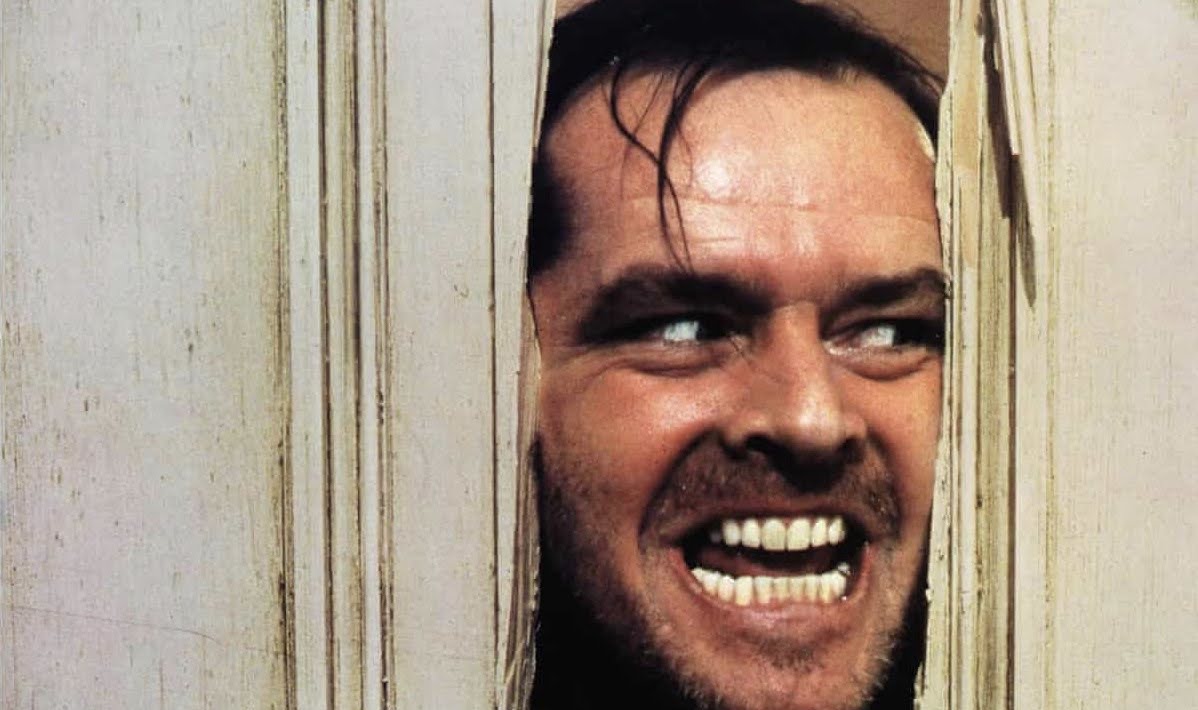
And they do...in some of the most haunting images ever put on screen:  the camera following Danny as he endlessly rides his Big Wheel tricycle through the halls of the empty hotel...and then comes upon the twin girls (“Come and play with us, Danny...”); “Redrum” scrawled on the wall and seen in a mirror by Wendy and realizing what it spells in reverse;  the guest in room 237; blood pouring out of an elevator; Jack, finally gone off the edge and coming after his family with an ax and announcing “Heeeeere’s Johnny!,” in probably the film’s most famous scene.


And that scene is just one of the many examples of how good Jack Nicholson is in this role.  With his trademark arching eyebrows and suspicious smile, it’s easy to dismiss Jack as “just doing Jack” as Jack, but he brings so much to even the quietest moments in the film, particularly those where he just stares blankly at the camera and is the true picture of a man slipping into madness.


It’s been well noted that Stephen King was not happy with this adaptation of his work and actually was involved in a TV mini-series remake of the film in 1997 for ABC.  


Fans have all respect for the author, of course, but feel differently about 1980’s “The Shining,” holding the film in high regard and immensely re-watchable, with multiple themes, messages and hidden meanings coming out of the film.


In 2013, King penned a sequel, “Doctor Sleep,” which was adapted into a successful film last year.  For the fourteenth anniversary of “The Shining,” Fathom Events, along with Turner Classic Movies, is hosting theatrical screenings of the film this week and the film has been the subject of multiple articles, blogs and You Tube videos lately.


So many remember and appreciate “The Shining” for what it is: Unsettling.  Nerve racking.  Morbidly funny.  Disturbing, Iconic.


Sources:

TCM.com

Wikipedia

Tuesday, October 20, 2020

Forgotten Frights: Lesser Known Halloween TV Specials


By Michael Lyons


If you’ve already watched “It’s the Great Pumpkin, Charlie Brown,”  as well as the seasonal TV Halloween offerings from everyone from Garfield to Shrek, you may have plumbed the depths of Halloween television specials.


Unlike Christmas, there isn’t a tremendous catalogue of television specials that theme to spooky season, at least from a popular perspective.  If you’re a fellow Halloween pop culture junkie, you would disagree, but many casual viewers may be looking for more small screen offerings to round out the season.


What follows are some Halloween TV specials that have all but fallen through the cracks into long-lost, You Tube obscurity.  They may help with not only adding to your season, but could also become part of your seasonal viewing rotation, for years to come:


“The Paul Lynde Halloween Special” (1976)


If you had a file of “This has to be seen to be believed” TV shows this would need to be at the forefront of that file.


The famously snarky comedian, with his trademark trembly voice hosts a special unlike anything you’ve ever seen.  


The hour packs in more guests than you can imagine: Florence Henderson, Tim Conway, rock group KISS (you read that right!), Roy Kelly (who starred as Pinky Toscadaro on “Happy Days”), Margaret Hamilton (reprising her most famous role the Wicked Witch from “The Wizard of Oz”) and Billie Hayes as Witchiepoo from “H.R. Pufnstuf.”  There’s even cameos from Betty White and Donny and Marie Osmond.


 “The Paul Lynde Halloween Special” fully embraces Halloween and also serves as a time capsule of the ‘70’s (complete with a sketch about CB radios) as well as a prime specimen from the golden age of TV variety shows.


If you have any interest in television’s past or pop culture, this special needs to be seen.  Just be warned, once it’s seen, it can’t be unseen and may just become part of your Halloween viewing rituals.


“Witch’s Night Out” (1978)


This Canadian produced animated special features a story steeped perfectly in Halloween, as it centers on a Witch who decides to do something about the fact that no one seems to be appropriately scared on Halloween.


Coming to a small town, she befriends three children and transforms them into a werewolf, a ghost and Frankenstein monster before they set out for a Halloween party.  This turns the citizens of the town into an angry mob and it’s the witch who must save the day.


There’s a nice, “Don’t judge a book by its cover” acceptance theme here that many may not see, as the animation is overtly-stylized (each character is a different color and shape and the main character of the witch doesn’t look like your traditional Halloween witch),  This is really more of a product of the time in which the special was produced and actually adds to its lower-budget charm.


Plus, “Witch’s Night Out” features comedy legends Gilda Radner and Catherine O’Hara as voices, so that, coupled with pure curiosity, makes this special one to check out if you’ve never seen it.


“The Halloween That Almost Wasn’t” (1979)


The concept of all the world’s most popular monsters coming together is a trope that has been used many times through the years, from 1967’s “Mad Monster Party” to 2012’s “Hotel Transylvania.”


But none of them did so while utilizing a cast of some of TV’s biggest stars of the ‘70’s.


In the live-action “The Halloween That Almost Wasn’t,” Dracula (Judd Hirsch), the Wolfman (Jack Wiley), Frankenstein’s Monster (John Schuck), Igor (Henry Gibson) and the Mummy (Robert Fitch) must convince a Witch (Mariette Hartley) to make her annual flight across the moon, so that Halloween can actually happen (apparently that’s a thing!).


The special was directed by Bruce Bilson, a veteran of such shows as “Get Smart” and “The Odd Couple” and has some of the quick, one-line joke sensibility of a sitcom, which is all delivered perfectly by the cast of TV veterans who balance tongue-in-cheek with earnestness.


It’s also another great time capsule, as “The Halloween that Almost Wasn’t” concludes with the characters at a disco.  What better place to spend Halloween?


“The Halloween Tree” (1993)


Based on a famed novel by legendary author Ray Bradbury, this animated special from the Hanna-Barbera Studio follows four friends who, while out trick-or-treating on Halloween night, go out in search of their lost friend and meet up with the mysterious Mr. Moundshroud (voiced by Leonard Nimoy) who teaches the children about the history and heritage of Halloween traditions in a most magical way.


Narrated by the author Ray Bradbury himself, “The Halloween Tree” is compelling, mysterious and, yes, educational.  However, at a little over an hour long, with a limited budget, the story screams out for a bigger, feature-length treatment, especially since the book is so beloved.


Hollywood, if you’re listening, “The Halloween Tree” is ready for a re-boot.


As Halloween of 2020 looks to follow suit with the rest of the year and be most...unique...any of these specials, once dusted off, could prove to be perfect companions during “spooky season,” in what’s already been a most spooky year.


Sources:

IMDb

Wikipedia

Thursday, September 24, 2020

Two Much: The 50th Anniversary of TV’s “The Odd Couple”


By Michael Lyons


“On November 13, Felix Unger was asked to remove himself from his place of residence; that request came from his wife. Deep down, he knew she was right, but he also knew that some day he would return to her. With nowhere else to go, he appeared at the home of his friend, Oscar Madison. Several years earlier, Madison's wife had thrown HIM out, requesting that HE never return. Can two divorced men share an apartment without driving each other crazy?” 


With these words from a baritone narrator, one of the sharpest, funniest and underrated sitcoms opened each episode.


“The Odd Couple” was based on a popular Broadway play and big budget movie by the brilliant Neil Simon.  As the narrator stated, it focused on Felix (a photographer and neat freak) and Oscar (sportswriter and a slob) who are forced to live together after their divorces.


Played to perfection by Jack Klugman, as Oscar and Tony Randall, as Felix, the two actors truly defined comic acting chemistry on the show.  This week marks the fiftieth anniversary of “The Odd Couple’s” debut on television and the perfect time to celebrate this enduringly entertaining sitcom.


After its success on stage and the big screen, “The Odd Couple” was shepherded to television by Executive Producer Garry Marshall, who would emerge as a sitcom wizard in the ‘70’s, with other classic shows like “Happy Days” and “Laverne & Shirley.”


“The Odd Couple” reveals the same knack for character and timing found in Marshall’s later shows.  Additionally, the ongoing, weekly format of the show allowed to expand on the characters, as the play and movie hadn’t been able to.


On “The Odd Couple,” Felix and Oscar would find themselves in such situations as contestants on game shows like “Password” and “Let’s Make a Deal,” as monks on a retreat at a monastery and even playing role reversal, to help “cure” each other’s neatness and slobbery.


These unique character traits also lent itself to some of the shows funniest and iconic moments:  Oscar’s bedroom of disarray was always one of the best sights gags on the show (“Everything you’ve ever owned is in that room!” Pronounced Felix); Felix vacuuming Oscar’s cigar smoke out of the air; Oscar bursting open a beer and a bag of chips, while Felix prepares a gourmet meal.


Jack Klugman and Tony Randall played their roles to a tee. Klugman’s reactions and sarcasm, along with his pauses are the reasons he won an Emmy for the role of Oscar.


As Felix, Randall gives such a perfectly mannered performance in each episode that the fastidious character just feels real.


The two actors were good friends off-screen, which comes across in “The Odd Couple,” as the comedy comes from how much the roommates know each other.


The two being so diametrically opposed is what fueled “The Odd Couple.”  Felix, with his love of opera and ballet was the polar opposite of Oscar, with his obsession with sports and gambling and gave the show its energy.  


This also made “The Odd Couple” one of the greatest “New York Shows” of all time: while Oscar would be off covering The Mets, Felix would be talking about going to “The Met.”


Manhattan was a true, supporting player on the show (so much so that, in the last season, “The Odd Couple” shot a number of scenes on location in New York City).


In addition to the city, the show also had a solid supporting cast.  Al Molinaro got some of the biggest laughs as good friend, innocent Murray the Cop.  Gary’s sister, Penny Marshall kicked off her career as Oscar’s nasally sweet secretary, Myrna Tyrner.  There were also a number of recurring characters, such as Monica Evans and Carole Shelley, as the neighbors, the Pigeon Sisters (who were only in the first season), Eleanor Donahue as Felix’s girlfriend, Miriam, Janis Hansen as his ex-wife Gloria, Joan Hotchkiss played Oscar’s girlfriend, Nancy and as his ex-wife Blanche, Brett Summers (Klugman’s real-life wife at the time.  Ironically, the two would later divorce).


Left to right: Betty White, Allen Ludden, Jack Klugman and Tony Randall in the “Password” episode


As “The Odd Couple” increased in popularity, so did guest stars on the show.  Roy Clark, Richard Dawson, Paul Williams, Allen Luden, Betty White and controversial tennis player Bobby Riggs are just a few of the famous guests, and well as Howard Cosell and Monty Hall who starred in two different episodes.


But the true stars were Jack Klugman and Tony Randall who have gone on to arguably define the characters of Oscar and Felix for so many.   While Walter Matthau and Jack Lemmon originated the characters and, later, actors such as Ron Glass and Demond Wilson and Matthew Perry and Thomas Lennon portrayed Oscar and Felix, Klugman and Randall immediately come to mind when someone says “The Odd Couple.”


The show debuted on September 24, 1970 and lasted for five years, after which it lived on for some time in reruns.  “The Odd Couple” changed through the years. In a sign of its time, the opening narration was put in place by the network, as there was actual concern that audiences would think the characters were gay.  It was eventually dropped, in favor of just the show’s oh-so-catchy theme song.  Also, after the first season, the show transitioned to being filmed in front of a live audience, which changed (and improved) its dynamic.


Still, somehow, “The Odd Couple” doesn’t often surface during conversations about some of TV’s best and classic sitcoms, which is a shame.  While not heavy on controversy or commentary like many shows of the time, such as “All in the Family,” “The Odd Couple” focused on pure laughs, which it delivered episode after episode.


In many ways, however, “The Odd Couple” did comment on the power of friendships and how differences shouldn’t drive us apart, but instead, bring us together.


After all, if “two divorced men can live together without driving each other crazy,” can’t we all?


Above: the opening of the show in front of 1049 Park Avenue in New York City
Below: the author in front of 1049 Park Avenue in New York City


Sources:

IMDb

“Tony and Me” by Jack Klugman

Wikipedia 


Wednesday, September 2, 2020

“Back” to School: The 45th Anniversary of “Welcome Back, Kotter”


By Michael Lyons


Going back to school used to be easier...A LOT easier!


And a reflection of that easier, simpler time, (where the biggest decision for students was what metal lunch box to choose and what color Trapper Keeper to buy) celebrates a milestone this fall.


“Welcome Back, Kotter” debuted on ABC on September 9, 1975 and, as hard as it is to believe for the generation who grew up with the show, it is celebrating its 45th anniversary.


The show was inspired by the stand-up routine of comedian Gabriel Kaplan, in which he poked fun at his high school days.  Kaplan would also take the lead in the show, as Gabe Kotter, the unconventional high school teacher, who returns to his alma mater of James Buchanan High School in  Brooklyn, NY.


Kotter had once been one of the tough, “remedial” students in the school, who were dubbed “Sweat Hogs” and he now returns to teach a new generation of “Hogs.”


While the inspiration and star of the show belonged to Kaplan, it was the young actors playing the “Sweat Hogs” who soon moved to the head of the class, so to speak, in audience popularity.


There was Lawrence Hilton-Jacobs as smoother-than-smooth Freddy “Boom Boom” Washington, whose “Hi There” greeting and bright smile became a character moment that immediately elicited laughs.  There was Robert Hegyes as Juan Epstein, one of the toughest kids at Buchanan High, with a talent as a writer for notes to the teacher, all signed by “Epstein’s Mother.”


As the lovable “mensch,” Ron Palillo starred as the naive Arnold Horshack, whose eagerness to answer every question with his hand thrust in the air, while yelling “Oooh!  Oooh!  Oooh!,” became not just a hallmark of the show, but seeped into classroom culture for kids of the day.


Then, as lunkhead ladies man, there was Vinnie Barbarino, played by John Travolta, in the role that made him a star in the ‘70’s universe and catapulted him to some of the biggest movies of the decade like “Saturday Night Fever” and “Grease.”  Whether it was Barbarino asking “What?  Where?”  When he knew the answer, or dancing to his trade mark “Ba-Ba-Ba-Barbarino” theme song, Travolta demonstrated the timing and moves that would endear him to audiences for some time.


In fact, the entire Cast demonstrated this: the Sweat Hogs were like a Disco-era Marx Brothers, with Mr. Kotter as Groucho, trying to keep control, while humorously commenting on the proceedings.  In fact, Kaplan was such a Marx Brothers fan, that Groucho himself was supposed to guest star on the show, but the legendary comedian’s failing health at the time, sadly prevented that.  


Many early episodes of “Welcome Back, Kotter” contain some of the biggest laughs to come out of TV at this time.  “The Telethon,” where the class goes on live TV, is just non-stop funny, even after repeated viewings.


Adding to this was a solid supporting Cast, including Marcia Strassman, as Gabe’s wife Julie, whose dry humor perfectly off-set Gabe (particularly his jokey “family stories” that closed each episode) and veteran actor John Sylvester White as the stone faced, adversary, Principal Woodman.


Recurring roles on “Welcome Back, Kotter,” also helped kick-off careers, such as Charles Fleischer (later the voice of Roger Rabbit) as bully Carvelli and James Woods as Alex, the school’s Drama teacher.


Debuting on September 9, 1975, “Welcome Back, Kotter” initially stirred up controversy, as there was a fear that the show would glamorize juvenile delinquency and issues with schools in major cities at the time.  Once critics and audiences saw the show and how, in so many ways, innocent it was, it soon became must watch TV.


“Welcome Back, Kotter” was also a merchandise phenomenon and could be found everywhere from lunch boxes and comic books to action figures and board games (years later, Quentin Tarantino actually used this board game as part of John Travolta’s “audition” for 1994’s “Pulp Fiction”).  Essentially, if you stepped foot in any store at the time, you saw the “Sweat Hogs.”


The “Welcome Back, Kotter” lunchbox and board game


In its third season, the popularity of “Welcome Back, Kotter” began to wane.  Some attributed this to a change in its scheduled night and time and/or the fact that the Cast no longer looked high school age.


Despite this, forty-five years later, the popularity of this show can still be felt, not just from the generation who grew up with it, but many others, as well, who gladly say “Welcome Back,” every time they see a rerun.


Sources:

IMDb

Wikipedia

Friday, August 7, 2020

Rebel With a Cause: The 35th Anniversary of “Pee-Wee’s Big Adventure”


By Michael Lyons


In a 1986 episode of “At the Movies,” the weekly TV show of noted film critics Gene Siskel and Roger Ebert, they discussed films that they had dubbed “Guilty Pleasures.”


At the top of the list was “Pee-Wee’s Big Adventure.”  As Roger Ebert gushed over the film, he said: “Pee Wee has created a fairy tale universe as consistent and fascinating as “Alice’s Wonderland,” or the world of the Hobbits in “The Lord of the Rings.”


And 35 years later, many feel the same way.  How times have changed, “Pee-Wee’s Big Adventure” once considered a “guilty pleasure” that film critics had to begrudgingly admit that they enjoyed, has become beloved by several generations.


Released on August 9th, 1985, “Pee-Wee’s Big Adventure” not only launched a mainstream career for the titular star who, up to that point, had been a cult comedian, the film also introduced the world to the talent of Tim Burton, who would become one of movie’s most visionary directors.


The man-child character of Pee-Wee Herman was the brainchild of comedian Paul Reubens, who introduced him in stand up clubs and specials in the early ‘80’s.  The growing success of the character prompted Warner Bros to commission a script for a full-length feature film centering on the character,


After several different ideas, Reubens and co-writers Michael Varhol and Phil Hartman (who would go on to his own success on “Saturday Night Live”) penned a story that fit the character of Pee-Wee perfectly.  In the film, Pee-Wee goes on a cross-country search for his beloved bicycle, after it is stolen by his archnemesis, Francis (Mark Holton).


The whole adventure is set in a world that truly resembles a real-life cartoon, perfectly realized by director Burton.  “Pee-Wee’s Big Adventure” marked the feature film debut for Burton, after a brief stint as a Disney animator and director of live-action short films like “Frankenweenie.”


Hallmarks of his future films like “Beetlejuice” (1988), “Batman” (1989) and “Edward Scissorhands” (1990) are seen in his debut with “Pee-Wee’s Big Adventure,” as the film is a true, unique vision, taking place in a setting that seems to exist on the periphery of our real world.  This is especially true in the early scenes of Pee-Wee’s house, with its detail and Rube Goldberg inventions (including one that serves Mr. T Cereal!)


This adds to the childlike, innocent tone of the story, and of the character, which is no doubt why both the character and the film have been embraced by all ages.


Of course, it doesn’t hurt that the film also includes scenes and dialogue that seem to be tailor-made for the multiple VHS and Cable viewings that would follow the film’s initial, theatrical release.


Pee-Wee’s encounter with “Large Marge,” the scene at The Alamo and, of course, the “Tequila” dance number (that song has never been the same) have all been seared into the memory of fans who can reference them at will.


Speaking of references, lines of dialogue from “Pee-Wee’s Big Adventure” are now endlessly quotable:


“I meant to do that.”


“You don’t want to get mixed up with a guy like me.  I’m a loner, Dottie.  A rebel.”


“Pee-Wee, listen to reason-“. (Pee-Wee places a hand to his ear) “Shhhh!, I’m listening to reason.”


The memorable list goes on and on and each one of them another reason why “Pee-Wee’s Big Adventure” is so fondly remembered on its 35th anniversary.  Like so many well-crafted film comedies and fantasies, this film captures a sense of timeless whimsy, joy and fun.


For those through the years who have dismissed “Pee-Wee’s Big Adventure” as infantile and foolish, well fans would simply respond, in the words of Pee-Wee himself...


“I know you are, but what am I?”


Sources:

IMDb 

“At the Movies”

Wikipedia

Wednesday, July 22, 2020

“Fore” The Love of the Game: “Caddyshack’s” 40th Anniversary


Bill Murray and Friend In “Caddyshack”


By Michael Lyons


The late ‘70’s and early ‘80’s were somewhat of a Golden Age for comedians.  The success of “Saturday Night Live” at this time was huge, there was a proliferation of variety shows on which comedians appeared and comedy record albums were topping the Billboard charts.


Additionally, some of the biggest movies during this period were comedies, many of which have become classics.  Stand-up comedians were true all-stars at the time.


And, if that’s the case, “Caddyshack” was the All-Star Game.


Four of the biggest names in comedy, at that time (or really, any time) - Chevy Chase, Rodney Dangerfield, Ted Knight and Bill Murray - all starred together in the film, which was released on July 25, 1980 and celebrates its 40th this summer.


As “Caddyshack” hits this milestone, its the perfect time to “tee off” and take a look back at this movie comedy that’s become a favorite among fans who never tire of watching it and can instantly and constantly quote the film’s now iconic dialogue.


At its center, “Caddyshack” is a coming of age story about caddy Danny Noonan (Michael O’Keefe) who works at the exclusive Bushwood Country Club and finds himself at a crossroad in his life.  Influencing him are club members Ty Webb (Chase), a rich, eccentric golfer, Judge Smails (Knight) an uptight snob and Al Czervick (Dangerfield) a loud, crude millionaire.  In the middle of it all is groundskeeper Carl Spackler (Murray) who is obsessed with catching a gopher who is tearing up the course.


The film really exists for opportunities for these comedy icons to do their thing.


Left to right: Chevy Chase, Rodney Dangerfield, Dan Resin,
Ted Knight and Brian Doyle-Murray in “Caddyshack”

Chase is at his cool-sarcastic best here, replying to the insanity going on around him.  And, of course, his “Be the ball” speech to Danny has become a humorous, calming mantra for an entire generation.


Knight, with his familiar, deep voice is the perfect victim for his fellow comedians.  He doesn’t get many of the best lines, but he gets all of the best reactions, particularly in his scenes with Dangerfield and the now memorable “golf ball to the crotch” scene.


Dangerfield is...well...Dangerfield...brashly commenting on the proceedings with his great, one-liner style (“You must’ve been something before electricity,” he says to Smails’ wife).


As Carl, Murray creates an indelible, off-the-wall character, with his slack-jaw and slurred speech.  His “Cinderella story” scene (mainly improvised) and his obsessive, militaristic attitude toward the gopher is a comedic wonder to behold.


As Danny, O’Keefe turns in a low-key performance that could have faded into the background, but instead becomes the surrogate for the audience.  There’s also great support from a cast of solid, character actors, like Cindy Morgan, as sexy Lacy Underall, Scott Columby as tough-guy Tony and Bill’s brother, Brian Doyle-Murray, as manager Lou.


Left to right: Michael O’Keefe and Cindy Morgan
In “Caddyshack.”

Doyle-Murray co-wrote the screenplay, which was based on his experiences working as a caddy, when he was younger.  He collaborated with producer Douglas Kenny and director Harold Ramos on the script.


Ramis, who would go on to co-star in 1984’s “Ghosbusters” and direct other well-loved comedies like “National Lampoon’s Vacation” (1983) and “Groundhog Day” (1993), made his directorial debut with “Caddyshack” and showed a great knack for staging and executing crowd pleasing comedy.


From the scenes of the Gopher’s lair (pulled off with great, cartoon-ish puppetry and effects) to the infamous “Baby Ruth in the pool” scene as well as the “explosive” finale, Ramis proved he could helm visual, film comedy, but also allowed his cast the ability to bounce off and “riff” in many, quieter scenes in the film.


When it debuted, “Caddyshack” was a mild success at the box-office and critics were underwhelmed.  However, it came along at a time when cable TV was starting to become a part of every home.  Many caught up with the film through cable and enjoyed viewing after viewing, allowing “Caddyshack” to develop a unique, cult following through the years.  


Additionally, singer Kenny Loggins’ song “I’m Alright,” written as the film’s theme, has become an “ear worm” through the years, that still plays on the radio and has contributed to “Caddyshack’s” non-stop appeal.


Through it’s seemingly juvenile exterior, “Caddyshack” also slyly comments on the different layers in society (the “snobs vs. the slobs” as movie posters stated at the time) and the impact that different mentors can have on our lives.


While it’s not for everyone (some feel it’s slow and uneven), “Caddyshack” has held a secure place in the heart and funny bone of many in the four decades since its debut.  Golf courses around the world echo the lines from the film each day, from the ever growing number of fans, as many consider “Caddyshack” their go-to comedy that they never tire of watching and laughing with.


In fact, ESPN calls “Caddyshack” “perhaps the funniest sports movie ever made.”  Not a bad legacy for this All-Star Game of movie comedies.


Sources:

IMDb 

Wikipedia