Monday, March 8, 2021

Creature Features: A Look Back at Disney's Many Dragons


By Michael Lyons

Disney hasn't just cornered the market on animated mice.  This was evident this past weekend with the Studio's latest animated hit, Raya and the Last Dragon.  The film introduced us to Sisu; a magical creature called a "water dragon' (voiced by Awkwafina).  

Sisu joins a long list of "Disney dragons" that date back 80 years.  With Raya and the Last Dragon now joining the increasingly impressive list, it's time to look back at some of Sisu's long lost cousins from the Studio:


The Reluctant Dragon (1941)

A long-forgotten Disney feature that’s both live-action and animated (which begins in black and white and ends in color).  The live-action sections revolve around a tour of The Disney Studio, given to humorist Robert Benchley.  He gets to see several short, animated films and ends his tour by seeing the title short, The Reluctant Dragon.

An adaptation of a book by author Kenneth Grahame tells the tale of a young boy who enters a dragon’s lair and meets a dragon who would prefer to read poetry over fighting a knight.

The segment is funny and charming enough (especially the dragon's character design and personality), with full animation one would expect from Disney at this time, but don’t be fooled by the title.  The film is a studio tour with The Reluctant Dragon only comprising the last ten minutes or so of the film.

Still, it all makes for engaging Disney history lessons for any film fan.


Maleficent in Sleeping Beauty (1959)

The climactic battle of Disney’s beautifully animated fairy tale features the already imposing villainous Maleficent transforming into a fire-breathing dragon in one of the Studio’s iconic sequences.

Disney Legend, animator Marc Davis created and animated Maleficent, but another legend at the Studio, animator Eric Cleworth is responsible for the scenes involving the dragon.  Cleworth based the creature’s movement on a striking rattlesnake, which added a level of realism to the scene and made it one of Disney’s most memorable moments.


Madame Mim in The Sword in the Stone (1963)

The “Wizard’s Duel” is by far one of the highlights of Disney’s animated tale of Young King Arthur (adapted from T.H. White’s novel).  Sorcerer “Mad” Madame Mim promises Merlin the wizard that during the duel, she won’t transform into “make-believe things” like “pink dragons.”  Of course, that’s precisely what she does, in a memorable conclusion to the duel, made all the funnier by “Dragon Mim’s” cartoonish appearance and her comeuppance, as well.


Elliot in Pete's Dragon (1977)

In Disney’s live-action/animated musical, a young boy befriends a dragon named Elliot in a Maine small town.  The combination of the live-actors with animation allows for some very entertaining moments, and Elliot's design is pure Disney character magic.

He was crafted by artist Ken Anderson, another Disney Legend, who provided the character with a unique look - a large jaw, pink hair, tiny wings, and a pot-belly, along with vocal sounds provided by comedian Charlie Callas.  He is so charming that when Elliot has to use his invisibility power, we as the audience can’t wait for him to be back on the screen.  It’s no wonder that Elliot and the film have become a favorite of a generation.


Mushu in Mulan (1998)

In this adaptation of a famous Chinese folk tale, in which the title character takes her father’s place, joining the army and going off to war, Mulan gets assistance from a pint-sized dragon named Mushu (‘travel-sized for her convenience”).

Eddie Murphy’s lightning-fast, funny vocal performance makes Mushu welcome comic relief.  Animator Tom Bancroft based the character’s quick movements on those of Brer Fox from Song of the South, which is evident as Mushu is tough to keep up with, but we are always happy when we do. 


Elliot, again, in Pete's Dragon (2016)

In keeping with the Disney trend of remaking their past films in live-action comes this serious take on the musical original.  The difference between the two films is what makes this film worthwhile and entertaining in its own right.

Opening in 1977 (a nice nod, as this was the release year of the original), the remake once again tells the tale of a young boy and his dragon.  That’s basically where the similarities end, as this is a more mystical, E.T.-like take on the story (the film even goes on to take place in the 80s) complete with its own, different (and shaggier) version of Elliot.


Now that you’ve seen Raya and you’re in an animated, mystical mood, consider “dragon” out some Disney history with these movies.


Monday, March 1, 2021

The Laughs Are on Him!: The Best of Eddie Murphy's Movies


By Michael Lyons


There is a scene in 1988's Coming to America where Prince Akeem is so happy that he walks through the streets of Queens, NY, singing Jackie Wilson's "To Be Loved," at the top of his lungs.


Fans of the beloved blockbuster comedy may soon be doing the same thing themselves.  That’s because, this Friday, March 5th, Prime Video will debut Coming 2 America, a long-awaited and much-anticipated sequel to one of the '80's biggest films.


Almost 33 years after its debut, the original Coming to America has also become one of those repeatedly watched and quoted comedies.  It's also one of Eddie Murphy's best films.


The '80's king of box-office comedy starred as Prince Akeem, a pampered member of a royal family who travels from his kingdom in Africa to New York.  Here, he goes undercover, rebelling against his family's wishes of arranged marriages to find a true love of his own.


Directed by John Landis (who helmed several popular '80s comedies), Coming to America co-starred Arsenio Hall, James Earl Jones, Madge Sinclair, and Shari Headley.  The film was a perfect vehicle for Murphy, allowing him (and Hall) to perform some hysterical, supporting roles (in amazing prosthetic makeup) that have become classics.  The film also had sweetness and heart, as well as a nice message around charting one's course in life and the power of true love


In the sequel, Coming 2 America, Murphy is back as the Prince (most of the cast from the original also returns).  His highness goes back to Queens, this time is looking for a long-lost son.


“Coming 2 America”

The debut of this eagerly-awaited sequel brings to mind just how much audiences loved the original, as well as so many of Eddie Murphy's other films.

To commemorate Coming 2 America coming to our TVs, here is a rundown of just some of Eddie's other memorable movies:


 48 Hrs. (1982)


After capturing everyone's attention on Saturday Night Live and helping to revitalize the then-struggling show, Eddie Murphy burst onto movie screens like a force of nature in 48 Hrs.


As a convict forced to pair up with a gruff cop played by Nick Nolte, Murphy has so many tour-de-force memorable scenes in the film (the one in the cowboy bar is a star-making moment).  Murphy and Nolte had perfect chemistry, and director Walter Hill essentially created the "buddy movie" genre.  Multiple films like this followed (including a disappointing 1990 sequel), but none compare this to the original.


Trading Places (1983)


Murphy's first collaboration with his Coming to America director, John Landis, had him paired with fellow SNL-alum Dan Aykroyd.  The two find themselves part of a "social experiment" conducted by two millionaires (Don Ameche, Ralph Bellamy) who reverse the positions of a poor, street smart con artist (Murphy) and a wealthy, snobbish investor (Ackroyd) to see how they will fare.


Smart and sophisticated in its humor and its messages about stereotypes and economic hierarchies, Trading Places seems more relevant today than ever.


Beverly Hills Cop (1984)


At one time, this movie was one of the top ten grossing films of all time.  Looking back at it, one can see why.  Murphy, a Detroit cop who comes to Beverly Hills to unofficially investigate his best friend's death, was at the top of his game and held the screen (and the film) with his confident comic talents.

Plus, the scene with Murphy and art gallery employee Serge (Bronson Pinchot) is still absolutely hysterical. 


The Nutty Professor (1996)


Murphy was snubbed of an Oscar nomination for his role in this remake of the famous Jerry Lewis comedy as Sherman Klump, an overweight college professor. Through an experiment, he accidentally creates an obnoxious alter ego called Buddy Love (also Murphy).  Murphy was so good and funny in both roles, but with Sherman, he makes such a kind-hearted soul that a scene in which he is ridiculed by a stand-up comic (played by Dave Chappelle) quickly moves from funny to absolutely heartbreaking.


Mulan (1988)


Amid this serious epic Disney animated film, based on a beloved Chinese folktale about the main character who takes her father's place to go off to war and fight the Huns, came Mushu.


Murphy voiced the fast-talking, "travel-sized" dragon in rat-a-tat delivery that brings much-needed comic relief during the film's most serious moments.


Bowfinger (1999)


An extremely underrated comedy from director Frank Oz.  Steve Martin (who wrote the film) is the title character, a low-rent filmmaker who comes up with an unorthodox way to direct Hollywood's next blockbuster.


Murphy is so great here, in another dual role, as a self-centered action star and an innocent nerd who Martin convinces to star in the film.  Look for the scenes in which Murphy crosses a busy LA freeway for pure, physical comedy gold.


Shrek (2001)


Murphy's second animated vocal performance was as Donkey in DreamWork's hit (and subsequent franchise) about a gruesome Ogre (Mike Myers) who becomes a hero.


Murphy brought his usual comic talents and singing skills that create the film's infections musical high note of a finale.


Dreamgirls (2006) 


Murphy finally scored his first Oscar nomination for his role as James "Thunder" Early in this adaptation of the hit Broadway musical.  A unique role for the comedy star who brought his skills for mimicry (in this case of many singers of the time) and music to this performance that genuinely lights up the screen in every scene.


Tower Heist (2011)


In an all-star caper involving a robbery of a billionaire living in a Manhattan skyscraper, Murphy plays "Slide," an ex-con who helps mastermind the heist.  Not only does Murphy provide great street-smart comedy here, but he also works perfectly with his co-stars Ben Stiller, Casey Affleck, Matthew Broderick, and Gabourey Sibide in this solid ensemble comedy.


Of course, this list would include the original Coming to America and could consist of a number of the comedian's other film vehicles.

So, after you finish his latest Coming 2 America this weekend, why not have a Murphy binge-a-thon?  You can then go out in the street and sing all about it.


Monday, February 22, 2021

Super Sitcoms: “WandaVision’s” Classic TV inspirations


 By Michael Lyons

In addition to changing everyone’s weekly schedules, where we now eagerly log into Disney+ as soon as we wake up on Fridays, “WandaVision” has also provided a curious, new appetitive for classic TV sitcoms.

Since debuting on January 15th, Marvel’s latest show has had a jigsaw puzzle of an otherworldly plot that features super heroes Wanda (a/k.a Scarlet Witch)  played by Elizabeth Olsen, with her sorceress-like powers and her husband Vison, played by Paul Bettany, a super-human android.  The two live in an alternate reality that seems like something out of classic TV sitcoms - complete with opening credits and a theme song.

Stranger than that, each week seems to change decades, taking us from the 1950’s to present day.  The episodes include impressively reproduced sets, camera work and titles that are indicative of each era.

With this, in addition to keeping us guessing about what will happen each week, “WandaVision” also keeps us wondering about what sitcom that particular episode is based on.

Wanda...er wonder...no more.  What follows is a breakdown of each episode’s classic sitcom inspirations:


Episode 1: “Filmed Before a Live Studio Audience”  is almost a dead-ringer for a slew of ‘50’s and 60’s landmark sitcoms and mostly resembles The Dick Van Dyke Show (which ran on CBS from 1961-1966) and starred the title character as a writer for a comedy show, who lived in his cozy home in New Rochelle, NY with his wife Laura (Mary Tyler Moore).  Created by the legendary Carl Reiner, who originally came up with the idea for the show as a starring vehicle for himself, but after that pilot episode was unsuessful, the show was re-worked for Dick Van Dyke.

Episode 2: “Don’t Touch That Dial”  is an homage to a number of fantasy-based sitcoms of the ‘60’s particularly Bewitched (ABC, 1964-1972), the story of Samantha (Elizabeth Montgomery) a witch who is a happily married housewife and living in modern-day suburbia.  This sitcom is most notable for when  Dick York, the actor who played husband Darren, was replaced in 1969 by actor Dick Seargeant.  It was almost another bit of the sitcom’s magic in that both actors looked so much alike that audiences barely noticed!

Episode 3: “Now in Color” is a groovy re-do a number of 70’s sitcoms, but most notably The Brady Bunch (ABC, 1969-1974), one of the greatest “comfort food” shows in TV history, for a number of generations.  Like “WandaVision,” the Bradys aren’t without their weirdness, such as whatever happened to their dog Tiger and what was the deal with Cousin Oliver?

Episode 5: “On a Very Special Episode...” came after Episode 4’s break from TV sitcoms tributes.  This one seems to have taken a lot of its tone from the old TGIF ABC line-up from the late ‘80’s into the ‘90’s, most notably, Full House (1987-1995).  This has a nice, full-circle feel to it, as Olsen’s two older twin sisters, Mary Kate and Ashley Olsen rose to fame playing the cuter-than-cute Michelle Tanner on “Full House.”

Episode 6: “All New Halloween Spooktacular” takes its cue from the 2000’s favorite Malcom in the Middle (Fox, 2000-2006), the now seemingly forgotten well-crafted sitcom that dared to shed a light on an imperfect, dysfunctional family, with often hilarious results.

Episode7: “Breaking the Fourth Wall” designs itself around recent, documentary-like sitcoms, in which characters talk right to the camera.  This episode resembles most notably Modern Family (ABC, 2009-2020), the show that revamped the family sitcom format and kept us wondering, “What foolish, but lovable and hysterical thing with Phil Dunphy do this week?”


With only two more episodes to go and “WandaVision” continuing to keep us guessing, we can take comfort in the fact that when it ends, we can somewhat relive each surreal episode by binging on these and other classic TV shows that gave Marvel’s show its mojo.

In the meantime, we will just continue to obsessively log-on to Disney+ as our first Friday “to do” each week!


Monday, February 15, 2021

Play the Music! Light the Lights! “The Muppet Show”: An Appreciation


 By Michael Lyons

Pure joy.  That’s The Muppet Show.  And, what’s even more joyful is the fact that every season of Jim Henson’s wondrous show that ran from 1976-1981 at the height of “Muppet-mania,” will be coming to Disney+ Starting this Friday, February 19th.

The Muppet Show was a creative, comedic, and a musical flashpoint for a generation that gave us a  mismatched menagerie that included Fozzie Bear, Miss Piggy, Gonzo, Rowlf and so many more that would fill our TV screens with animalistic and monstrous shapes.  All of this was marshaled together by the already famous m.c. and ringleader, Kermit the Frog, who is manager of the cabaret theater where they all appear.

Jim Henson, with his quietly brilliant mind, had been attempting to create a prime time show starring his Muppets.  He and his team had a not-so-great experience when The Muppets were part of the first season of Saturday Night Live, but Henson took lessons learned from this, particularly around TV production and applied them to The Muppet Show.

For five seasons, starting in 1976, the show gave us some surreal, silly, and ultimately memorable moments, many of them featuring some of the biggest actors, singers and dancers in entertainment, all of whom clamored to be part of the insanity and join on the "Muppet-mania" pop culture popularity that was so prevalent at the time.  

Now, wondrously, thanks to the blessed technology known as streaming, we can enjoy them all, in and out of order. some of the highlights through the years include:

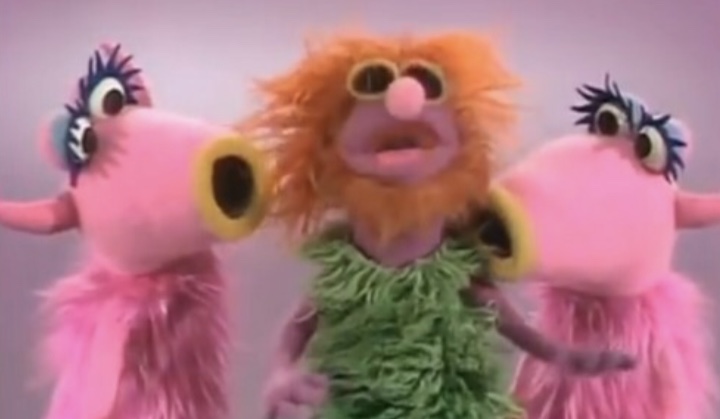
  • The now famous and oh-so-singable "Mahna Mahna" song from the first episode with guest Juliet Prowse.
  • A Muppet jugband singing "I'm my own Grandpa," also from season one.
  • Singer Rita Moreno signing "Fever," backed-up by Animal on drums, also from season one...and she won an Emmy for the episode.
  • Miss Piggy, always prone to violent outbursts, lets loose with her first karate chop in the season one episode with Florence Henderson.
  • From season two, Steve Martin, at the height of his own popularity, entertains a theater-full of Muppets with his trademark banjo-picking comedy.
  • A scientist Muppet sings Jim Croce's "Time in a Bottle," and as he does he continually gets younger, in this touching moment from season two.
  • Also from season two, Fozzie tries his "hand" on ventriloquism, when Edgar Bergen guest stars
  • From season three, Harry Belafonte singing his incredibly catchy song "Turn the World Around," which speaks of knowing where we've come from and world unity, in a number made all the more wonderful with Muppets that look to have been created for the number.  
  • In season four, "The Stars of Star Wars" were the guests: Mark Hammill as Luke, along with C3PO, R2D2 and Chewbacca.  All of them there just in time to promote the debut of The Empire Strikes Back that summer.
  • A boatload of Viking pigs sing The Village People's "In the Navy" (season five).  Enough said.
  • Then, there were the recurring segments such as “The Swedish Chef,”. “Muppet News Flash” “Pigs in Space” and “At the Dance.”
All of these scratch just the tip of the many moments that made up The Muppet Show.

Through the years, the show has been called sometimes bizarre, sometimes beautiful, sometimes comedic, sometimes touching.  But, there’s one thing The Muppet Show has always been: pure joy.


Monday, February 8, 2021

Love Lines: Movies’ Most Romantic Dialogue

By Michael Lyons 

Here we are, heading into another Valentine’s Day.  It’s probably the only holiday where socially distancing is not encouraged (if you are thinking about staying six feet apart from your significant other, chocolate hearts and flowers are probably not the first things on your mind).

If you find yourself tongue-tied, as you try to find the right words to express how you feel, consider looking to the movies for some heartfelt inspiration.  What follows is a brief, not all-inclusive list of quotes from some of Hollywood’s most romantic films.  Some touching, some funny, all enjoyable...

Valentine’s Day (2010)

“When you love someone, you love all of them...you gotta love everything about them, not just the good things but the bad things too.  The things that you find lovable and the things that you don’t.”

The Notebook (2004)

“No matter what happens to us, every day spent with you is the best day of my life.”

Moulin Rougue (2001)

“The greatest thing you’ll ever learn is just to love and be loved in return.”

Ghost (1990)

“The love inside, you take it with you.”

The Princess Bride (1987)

“As you wish.”

Annie Hall (1977)

“This guy goes to a psychiatrist and says, ‘Doc, my brother’s crazy; he thinks he’s a chicken.’  And the doctor says, ‘Well, why don’t you turn him in?’  The guy says, ‘I would, but i need the eggs.’  Well, I guess that’s pretty much how I feel about relationships; ya know, they’re totally irrational, and crazy, and absurd...but I guess we keep going through it because most os us need the eggs.”

Some Like it Hot (1959)

 - “I smoke, I smoke all the time!”

 - “I don’t care.”

 - “Well, I have a terrible past.  For three years now, I’ve been living with a saxophone player!”

 - “I forgive you.”

 - “I can never have children.”

“We can adopt some.”

 - “But you don’t understand...I’m a man!”

 - Well...nobody’s perfect!”

An Affair to Remember (1957)

“We’d be fools to let happiness pass us by.”

Cinderella (1950)

“So this is love.  So this is what makes life divine.”

The Philadelphia Story (1940)

“The course of true love...gathers no moss.”

It Happened One Night (1934)

 - “What are you thinking about?’

 - “By a strange coincidence, I was thinking of you.”


As with any movie quote, each of these are better when heard in the context of the entire story and the complete film.  So, consider watching some or all of these and the many other romantic films Hollywood has to offer for a “socially close” evening at home with the one you love.

Happy Valentine’s Day!


Monday, February 1, 2021

Football Takes its Shot: Remembering the All-Star 70’s Movie “Two Minute Warning”


By Michael Lyons

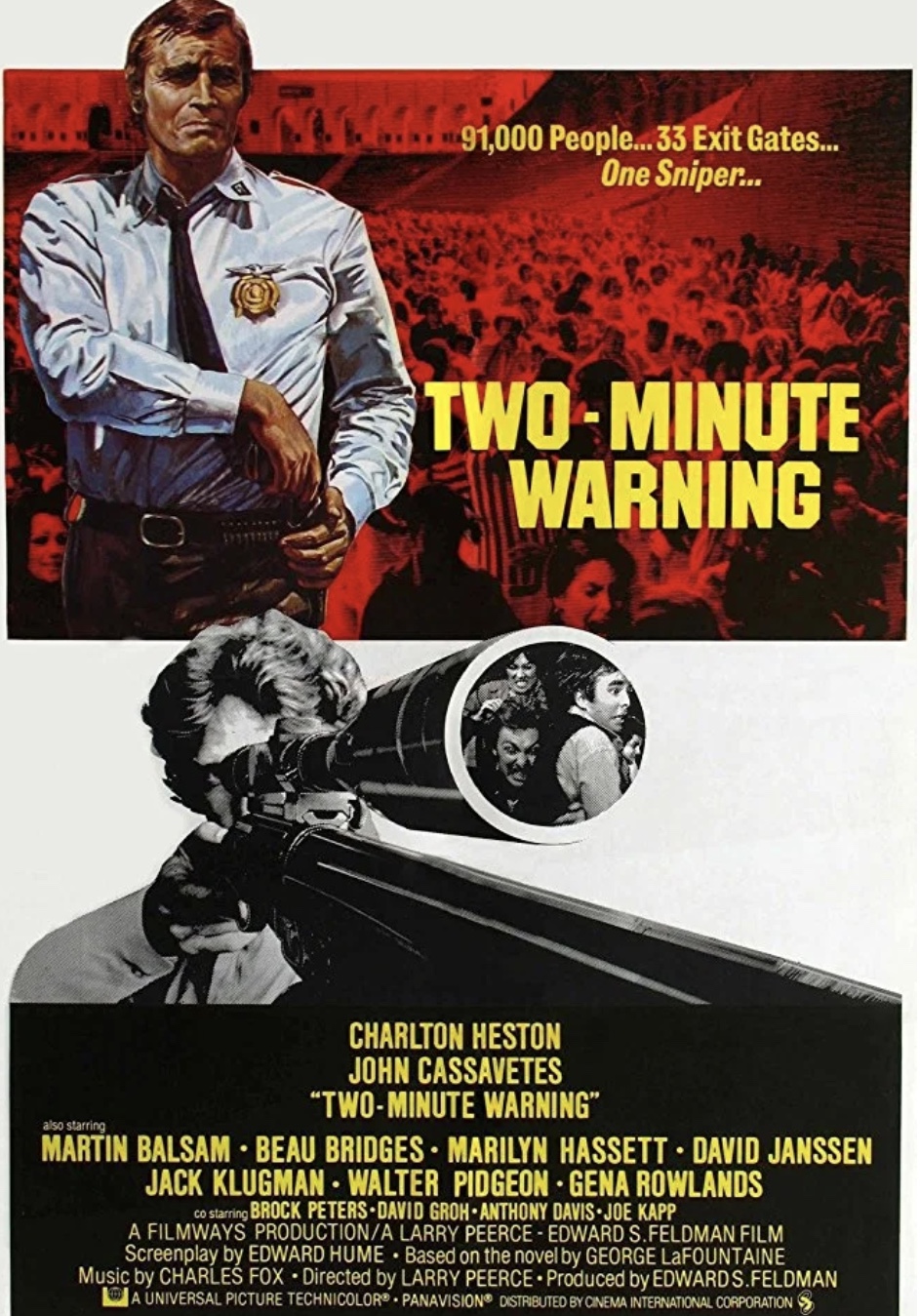
Guilty Pleasure Movies don’t feel guiltier than Two Minute Warning.  Released 45 years ago and made at the height of Hollywood’s star-studded disaster movie fad, this thriller about a sniper at a professional football game plays like a dangerous version of TV’s The Love Boat and is immensely watchable.

Best of all, it’s also perfect viewing to add to movie watching that can help get one geared-up for The Super Bowl (putting out of your mind just how dangerous the movie’s melodramatic plot about a gunman truly is!),

Two Minute Warning opens as an unknown and faceless sniper positions himself at Los Angeles Memorial Coliseum, where the “Championship X” game (generic substitute for The Super Bowl) is about to start.  The sniper is soon spotted by a Goodyear blimp and the police and SWAT teams are both called.

So begins the macho showdown between Charlton Heston as the Police Chief and John Cassavetes as the SWAT Seargent.  As they put their plan together during the game, we are introduced to the all-star parade of popular and character actors playing the fans and others at the stadium: Beau Bridges as a dad with his family in tow; David Janssen and Gena Rowlands (Cassavetes real-life wife) as an estranged couple; Jack Klugman as a gambler in trouble with the mob; Walter Pidgeon as a pickpocket; Brock Peters as the Stadium Maintenance Director and Martin Balsam as the Stadium Manager

As we cut back and forth between each of these stories throughout the film and the game unfurls, the police and SWAT teams prepare to go after the sniper (which they do at the game’s...two minute warning). The sniper then opens fire and the crowd panics, as everyone rushes to clear the stadium resulting in a bloody and frenetic conclusion to the film, that, sadly, seems more realistic today than the fictionalized action it was when Two Minute Warning was released 45 years ago.

Even at the time, the conclusion was deemed so intense that, when it was shown on network television three years after its release, newly filmed footage was inserted, including a sub-plot about an art heist, to allow for the more violent scenes to be excised. 


Released on November 12, 1976, Two Minute Warning was helmed by Larry Peerce, a journeyman director who worked quite a bit in film and TV in the ‘70’s and here does a nice job balancing tension, action and even, at times, comedy,  

Two Minute Warning, despite its serious subject matter, plays out at times like an innocent “time capsule” (complete with full-on ‘70’s fashion statements).  

Like the buffalo wings, nachos and beer you’re about to gorge on Super Bowl Sunday, you’ll consume Two Minute Warning quickly and enjoy it...you may just feel incredibly guilty afterward.


Don’t forget to follow “Screen Saver” on Facebook and Twitter:

 Facebook:  https://www.facebook.com/Screensaverblog/ 

Twitter:   @ScreenSaverBlog

Tuesday, January 12, 2021

Those Were the Days: The 50th Anniversary of “All in the Family”


By Michael Lyons

There was a seismic shift on January 12, 1971, but it wasn’t registered on any Richter scale.  It happened on TV and the landscape would never be the same.

After decades of wholesome families and fantasy settings, sitcoms got real, really real when All in the Family debuted on January 12, 1971,

The sitcom was the brainchild of Norma Lear, who based the show on the UK  series, Til Death Do Us Part, but with All in the Family, Lear stripped away all that was familiar about TV shows and added in all that was considered forbidden.

The show would very straightforwardly tackle such sensitive topics such as prejudice, politics, women’s liberation, The Vietnam War and religion, just to name a few.  All in the Family did all of this while never losing the humor or drama called for and the brilliant points and messages lying underneath each episode.

The show, set in Queens, New York, centered on Archie Bunker, played brilliantly by Carol O’ Connor, who not only won four Emmys for his portrayal, but also created one of television’s most indelible and enduring characters.  Bunker was a narrow-minded, bigoted, outspoken member of the Greatest Generation who was never at a loss for speaking what was on his mind, no matter what slur came along with it.

With him was his wife, Edith, who was as kind and innocent as Archie was harsh.  Played perfectly by Jean Stapleton, who won three Emmys for a role that gave new meaning to devotion, optimism and made a high-pitched “New Yawk” voice hysterical to listen to.

Living with the Bunkers was Archie and Edith’s daughter, Gloria (Sally Struthers) and her husband Mike (Rob Reiner), who was the complete opposite of Archie and represented the younger, liberal, hippie generation.  Archie would go on to, of course, refer to his son-in-law affectionately, as “Meathead.”

The clashes between Mike and Archie were often where the show’s messages came across.  Archie’s unfiltered language was controversial and shocking to audiences at the time (both in the studio and at home), but Lear used the character so ingeniously in the show.  Archie Bunker was politically incorrect before that was a thing, but he wasn’t used to offend, he and the show were a way to open minds and hearts at another time in our country’s history when there was a need for that.

All in the Family came on TV as a mid-season replacement and didn’t truly catch on with audiences until the summer of 1971.  The show then went on to be the number one show in the Nielsen Ratings from 1971-1976 and spawned a number of spin-offs, including Maude (1972) and The Jeffersons (1975).

The show also gave us the immensely memorable theme song, “Those Were the Days,” with Edith’s off-key signing, that’s become one of the most famous of TV’s tunes.

More than a theme song, All in the Family is a milestone in television history.  TV Guide ranks it at the number 4 spot on its list of the 50 Greatest TV Shows of All Time.  As it celebrates its 50th anniversary this month, it’s important to not only acknowledge the show’s impact but how it also paved the way for so much of the important, relevant TV that we enjoy today.

For eight years, All in the Family, held a mirror up to society and showed our reflection in the characters.  Through the laughter, we learned more about acceptance, peace and unity, among many other of life’s invaluable priorities.

All in the Family did indeed provide a seismic shift and one that we could benefit from today.