Thursday, May 26, 2022

Road Rage: The 45th Anniversary of "Smokey and the Bandit"


By Michael Lyons 

"The film I had the most fun on was Smokey and the Bandit," - Burt Reynolds in a 2015 interview.

That fun had by Reynolds seems to be reflected by everyone involved in Smokey and the Bandit, and audiences who have watched it enjoyed it and become fans in the forty-five years since it was released.

The story is simple, a hotshot, local legend driver, named Bo "Bandit" Darville (Reynolds in his most iconic role) and Cledus "Snowman" Snow (Jerry Reed, as the perfect, amiable sidekick) accept a bet from a rich father-and-son Big Enos and Little Enos (Pat McCormick and Paul Williams).

Bandit and Snowman must drive from Atlanta to Texarkana and back again in 28 hours to bring back 400 cases of Coors beer (at the time, transporting Coors east of the Mississippi was still considered bootlegging and was illegal).

While en route, the two pick up a runaway bride named Carrie (Sally Field, who was so great with Reynolds, it's no wonder they had chemistry on screen and off) in Bandit's sleek, black Trans Am. They are all pursued by Sheriff Buford T. Justice (Jackie Gleason, in a role that became as iconic for him as Bandit did for Reynolds).  Along with Justice is his dim-witted son, Junior (a hysterical Mike Henry).

All of this is directed by Hal Needham, a veteran stuntman who made his debut with this film and brought his skills to the proceedings.  After all these years, the speeding, chasing, and destructive automobile choreography is still a marvel to watch.

Smokey and the Bandit is easy to take as a warm summer afternoon.  It hit squarely upon the CB craze of the time but also hits squarely with its laughs, thanks to its stars.

Reynolds has never been more charming, with his trademark smirk and high-pitched laugh.  This film was at the height of his box-office ascension, and it's easy to see what audiences responded to.  Field proves to be the perfect contrast: an outsider bemused by all that's going on as the world speeds by.

And Gleason created one of the most memorable characters of the decade and, many say, in comedy history.  Sheriff Justice also brought with him endlessly quotable, profanity-laden lines ("You someb****!" "I'm gonna bar-b-q your a** in molasses!" and "What we have here is a total lack of respect for the law!").

Initially, Needham's movie had a modest budget and generated little interest until Reynolds signed on.  With a script that was constantly being revised, most of the scenes in the final film were improvised.  This included a now-famous meet-up between Justice and the Bandit at a diner (the "Diablo Sandwich" that Justice orders here has become such a curiosity among fans that recipes have surfaced online).

Released on May 19, 1977 (at Radio City Music Hall!), this low-budget, mostly improvised car chase movie made $126 million in the states, coming in as the second highest-grossing film of the year - behind Star Wars!

The popularity of Smokey and the Bandit inspired several copycats, such as the film Convoy (1978) and TV's The Dukes of Hazzard.  

It was a moment in time that was short-lived, and even by the time the sequel Smokey and the Bandit II hit theaters in 1980 (and definitely by the time the strange Smokey and the Bandit Part 3 came along in 1983), the car chase/car crash comedy seemed to be fading as a genre.

But, Smokey and the Bandit still stands out as an immensely enjoyable and, as Reynolds said, fun film

As the film celebrates its 45th anniversary this summer, it's always an entertaining ride for audiences to hop in Bandit's Trans-Am with Sheriff justice in high-speed pursuit!


Sources: Cheatsheet.com

My book Drawn to Greatness: Disney's Animation Renaissance is now available on Amazon!

For more of my articles, head over to my web site, Words From Lyons

Thursday, May 19, 2022

Rerun Relief: Looking Back on "Summer Replacement Shows"

Tony Orlando & Dawn
By Michael Lyons

Another TV season is coming to a close.  However, it seems as if the TV season never ends in our current world.  Streaming now brings an endless supply of new shows, even during what was once considered the barren wasteland for television networks: summer.

At one time, the major networks looked upon the summer season of beaches, pools, bar-b-ques, and vacations as a time when people were not sitting at home and watching tv; instead, reruns ruled the schedule, and the networks regrouped for the new TV season in the fall.

However, a tactic became so popular among the three major networks - ABC, NBC, and CBS, that there was even a term for it: "The Summer Replacement Show."

These were new shows that would be produced specifically for the short two-three month stint of summer, in place of reruns, to try and coax audiences back in front of their TV screens.

What follows are just some of these "summer replacements," some famous, some forgotten and some now just a "misty water-colored memory" of the "lazy, hazy, crazy" summer TV days of the past.


The Ken Berry 'Wow' Show (ABC, Summer, 1972)

Ah, the era of a variety show! Berry, The F-Troop star, got the chance to showcase his singing and dancing talents with his variety show, which came with a very '70s name, look, feel, and overall time-capsule-like tone of the decade.

In addition to comedy sketches, Berry's show also featured several famous guest stars, including Carol Burnett, Phyllis Diller, and George Burns.  Also, the show provided a career kick-off for regulars Teri Garr, Cheryl Ladd, and Carl Gottlieb, who would go on to a career as a screenwriter, penning such films as Jaws (!) as well as a young comedian named Steve Martin.


The Burns and Schreiber Comedy Hour (ABC, Summer 1973)

When comedy teams were popular came this duo, a favorite on variety shows, who were given a chance at their own variety show during the summer of '73.

Jack Burns, with his deep voice and "slick" tone, and Avery Schreiber, with his wild hair and physical comedy, were a good match, and they had great chemistry together in sketches.  They would also end the summer in "grand style," co-hosting the "Preview Show" for the line up ABC's offerings on Saturday mornings.

Burns and Schreiber would eventually go their separate ways. Schreiber went on to star in several TV shows and movies, including Mel Brooks' Robin Hood: Men in Tights (1993), and became well known for a number of years as the spokesperson for Doritos.  

Burns transitioned behind the camera, entertaining a new generation as he became a writer for The Muppet Show and co-wrote the script for The Muppet Movie. 


Tony Orlando and Dawn
 (CBS, Summer, 1974)

The group responsible for hit songs like "Tie a Yellow Ribbon" and "Knock Three Times," which seemed to provide the soundtrack for the '70s, were given their own variety show during the summer of 1974.

The show was initially brought in to replace the popular Sonny and Cher Show (which started as a summer replacement show) after that famous couple broke up.  Tony Orlando and Dawn proved so popular that they eventually continued into the regular network schedule beyond the summer and aired for another two years.


The Seinfeld Chronicles (NBC, Summer, 1989)

Before it made history as "the show about nothing" and was renamed just Seinfeld,  Jerry had this modest sitcom that debuted quietly in July of 1989.  The first episode starred Seinfeld and Jason Alexander, with Michael Richards as a character named "Kessler," not Kramer.

Julia-Louis Dreyfus would later join the show, making it complete. NBC would temporarily add the show to its regular schedule in May of 1990 and then as a permanent prime time member in 1991.


Northern Exposure (CBS, Summer, 1990)

This quirky show about the inhabitants of a small town in Alaska, starring Rob Morrow and Janine Turner, at first, seemed like a more grounded version of Twin Peaks.  It was shuffled into the summer line-up, which helped it find its audience, and it became a popular favorite on CBS and part of the network's regular line-up for five years.


Who Wants to Be a Millionaire (ABC, Summer, 1999)

Regis Philbin hosted this blockbuster adaptation of the same-titled British game show that became so popular from its initial summer run that it not only joined ABC's regular prime-time line-up but, for some time, it was shown multiple nights during the week.

It also entered our pop culture lexicon ("Is that your final answer?") and has gone on to have new iterations, hosts, and re-boots (including the most recent, hosted by Jimmy Kimmel, airing in 2020).

Who Wants to be a Millionaire also kicked off a trend where networks look to produce game shows, and reality shows, as part of their summer line-up.


New versions of these types of shows continue during the warm weather months (Family Feud and 100,000 Pyramid will be back this summer), as do other new shows that continue to be introduced during this season.

So, while the term "Summer Replacement Show" isn't used as much anymore, it's safe to say that networks (which now include endless cable and streaming services) have learned their lesson about the summer season.

It's not the barren wasteland once thought, and sunburned viewers may just find themselves watching next fall's biggest hit.


Tuesday, May 3, 2022

"Force'-ful Nostalgia: Remembering the "Summer of 'Star Wars'" 45 years Later

Moviegoers outside the Lowe's Astor Plaza theater in New York City, 
waiting to see Star Wars, in 1977.

 By Michael Lyons

I have a very vivid memory from the summer of 1977.  My family was at the beach (Robert Moses State Park Beach, in Long Island, NY, to be exact), and as I stood knee-deep in the water with my Dad, Uncle and cousins, I remember my Uncle Dennis saying, "Hey, we all went to see this movie Star Wars the other night..."

And as Uncle Dennis proceeded to explain the plot of this movie, detailing the "spaceships" and describing this character called "Chewbacca," my 11-year-old mind was reeling.

I have another very vivid memory from that same summer of 1977.  It's from about a week later when my Dad (just as much a movie fan as I am) took me to the movie theater (The RKO Twin Theatre in Commack, NY, to be exact) to see Star Wars.

And, while I do remember so much from that night, from having to wait in line to see it (something I had never done before) to the adults in line complaining about the price of the ticket ("$4.00 to see one movie?!"), the thing I remember the most is that communal experience of sitting in the jam-packed, air-conditioned theater and watching Star Wars.

The science-fiction-fantasy-unlike any-ever-before-seen story of Luke Skywalker, Obi-Wan Kenobi, Han Solo, and Princess Leia going up against the evil Empire unfurled across the screen.

It's one of those moviegoing experiences you never forget.  That indelible opening shot of the Star Destroyer seemingly soaring over our heads onto the screen; this enigmatic villain called Darth Vader terrifying us with every labored breath; a Cantina full of the strangest, most creative creatures I had ever seen since watching Planet of the Apes at home and, of course, finally getting to see what a Chewbacca was.

Most of all, I remember the audience's reactions.  Laughing at jokes that seemed to come at the film's most dangerous times ("One thing’s for sure, we are all going to be a lot thinner!") and applauding at the end of the film as the Death Star disappeared in an explosion that seemed both realistic and fantastic.

I had never been part of an audience like this before.  Most of the movies I went to see up to this point were Disney movies, (re-issues of past animated feature film classics, and live-action Dean Jones outings).  That summer of '77 had seen the debut of a brand-new Disney animated film, The Rescuers, which I had seen just several weeks prior, and loved.

But that, like so many other Disney animated films, was usually an afternoon at the movies, where I was "dropped off" with friends or a parent begrudgingly accompanied. The entire theater was mainly comprised of kids who (to my annoyance, even at a young age) would many times talk during the movie.

With Star Wars, I was in a theater at night with adults, teenagers, and other kids, of all ages.  And as we all laughed, gasped, and applauded, sometimes so loud that we were drowning out the dialogue on screen, we all seemed to be collectively enjoying and experiencing the film together.  

Star Wars newspaper ad from 1977


And, with
 Star Wars, the whole world seemed to be experiencing the same thing.

The film debuted in fewer than 32 theaters on Wednesday, May 25, 1977, and earned over $2 million through Memorial Day Weekend, a whopper of a box office at the time.

Movies (and specifically summer movie season) changed forever.  Jaws had "turned the tide" two years earlier, and Star Wars sent the movie industry into "hyperspace."  In 1999, film critic Roger Ebert noted, "Star Wars effectively brought to an end the golden era of early-1970s personal filmmaking and focused the industry on big-budget special-effects blockbusters, blasting off a trend we are still living through."

And the "Summer of Star Wars" turned into the fall, Christmas, and school year of Star Wars, as my friends and I sported our iron-on Star Wars T-Shirts, played our Star Wars board game, marveled at our Kenner "Early Bird Certificate," listened to the Meco disco version of John Williams' music, proudly displayed our "Darth Vader Lives" buttons and let Star Wars consume our almost every waking hour.

One of the many pieces of early Star Wars
merchandise from 1977.


My story is not unique.  So many fans have similar stories of the time they were first introduced to Star Wars, whether during the summer of 1977 or one of the sequels, prequels, animated shows, streaming series, theme park attractions, entire theme park lands, and on and on and on.

Celebrating its 45th anniversary this summer, Star Wars has become a more extensive collective experience that has had a staying power no one at the RKO Twin Theater could have predicted on that summer night in 1977.

And, sure, there have been similar, indelible moviegoing experiences since: E.T.: The Extra-Terrestrial, Back to the Future, Jurassic Park, The Lord of the Rings trilogy, and a number of the Marvel films come to mind. 

But none have had the impact that Star Wars had four and a half decades ago.

And, why is that?  A quote from George Lucas seems to sum it up best.  He once said, "... I set out to make a film for a generation growing up without fairy tales."

Well done.  Thank you for the wonderful, vivid memories.

Happy 45th Anniversary, Star Wars.  And, May the Fourth Be With you!

 Sources:

rogerebert.com

CBSFox Home Video

Learn more about my new book Drawn To Greatness

For more of my writing visit my websiteWords From Lyons 


Thursday, April 28, 2022

Read All About It!: The 30th Anniversary of "Newsies"


By Michael Lyons

The story of a group of underdogs who are initially counted out but eventually "seize the day"  is not just the story of the characters in Newsies; it's also the story of the film itself.


Disney produced it during the early years of their Animation Renaissance when films like 1989's The Little Mermaid and 1991's Beauty and the Beast became landmarks.  Many noted that animation was the new home of the movie musical.  Disney decided to do one better and attempt to bring the musical back in live-action with Newsies.


Celebrating its 30th anniversary this spring, the film is based on the real-life events of an 1899 newsboy strike in New York City.  Newsies (the nickname for the newsboys) would re-tell this story with lots of singing and big, musical numbers.


Released on April 10, 1992, Newsies made only $2.8 million at the box office. Compared to the $145 million that Beauty and the Beast had just brought in domestically, Newsies' failure to ignite audience interest couldn't be ignored.


However, this was also a time when an entire generation of children was being raised by their VHS players, allowing them to enjoy movies over and over and over and over again.  And while this may have been to the dismay of many a parent, it proved to be a benefit to many a movie studio, whose less than successful films could now find an audience.


This was especially true at Disney, most notably in the 1990s.  The studio's animated features The Nightmare Before Christmas (1993) and A Goofy Movie (1995), both initially box-office disappointments, had newfound life thanks to home video.


As did Newsies. Thanks to VHS, the film was so popular with home rentals and purchases; it made its budget back.


There was a tremendous amount of talent involved in the film, from stars such as a young Christian Bale (singing, no less), Bill Pullman, Ann-Margret, and Robert Duvall (as none other than Joseph Pulitzer).

Kenny Ortega directed and would also helm Hocus Pocus, another live-action Disney movie from the '90s that would develop an immense following years after its release.  Additionally, Ortega would go on to direct the hugely popular High School Musical series of films for Disney.


And the songs in Newsies were composed by Alan Menken, the musical wizard behind the animated hits of the era, who here was partnered with Jack Feldman (also behind songs for A Goofy Movie).

And some of the songs are catchy little numbers, including the rousing anthem "Carrying the Banner" and the showstopper "King of New York."


The groundswell of popularity for Newsies was such that it was adapted into a Broadway musical twenty years after the film's debut.


In 2012, Newsies: The Musical opened at the Nederlander Theater in New York and went on to tour after.  New songs were added, and some plot and character changes were made. It received several Tony nominations, including Best Musical, winning the Best Choreography and Best Original Score award.


After it completed its tour, the show was so popular that Disney re-issued the film Newsies to theaters for a limited run in 2017, which wound up grossing $3.47 million, more than the film made during its initial release.


Thirty years later, the story of Newsies the film is a great comeback story about overcoming adversity for a movie that's all about overcoming adversity.


*My new book, Drawn to Greatness: Disney's Animation Renaissance is now available on Amazon:Drawn to Greatness


**For more of my articles, visit my web site: Words From Lyons


Thursday, April 14, 2022

Any "Bunny" Remember These?: Forgotten TV Easter Specials


The Bugs Bunny Easter Special (1977)

 
By Michael Lyons

These television Easter specials are like jellybeans buried under the fake grass at the bottom of the basket, and have faded into obscurity.

Unlike Christmas, Easter has never brought with it a plethora of TV traditions (the shortlist would probably be It's the Easter Beagle, Charlie Brown, and Here Comes Peter Cottontail), which makes these specials even more interesting to seek out. 


The First Easter Rabbit (originally aired on April 9, 1976)


Rankin/Bass, the studio synonymous with so many Christmas specials, brought us this Easter Rabbit origin story, narrated by Burl Ives (Sam the Snowman from Rudolph the Red Nosed Reindeer) as the Rabbit who tells the story.


The First Easter Rabbit centers on Stuffy (Robert Morse), a stuffed rabbit given to a young girl named Glinda as a Christmas present.  In a sad, dark turn, Glinda is diagnosed with Scarlet Fever and all of her belongings, including Stuffy, need to be burned to stop the sickness from spreading.


Stuffy is rescued by a sprite named Caliope, who takes him to Easter Valley (located at the North Pole and Santa himself watches over it).


Stuffy and the other rabbits of Easter Valley face Zero, the evil ice wizard, and his sidekick Bruce the Snowball, who are trying to capture the Lily of Easter Valley.  If they do, there will be no Easter.


The First Easter Rabbit is told in comforting Rankin/Bass 2D animation, with great designs by artist Paul Coker, Jr.  Also, the studio's stalwart voice actor Paul Frees is featured as several characters, including Santa.


Irving Berlin's Easter Parade is utilized so well in The First Easter Rabbit, during a lovely finale that plays out in pure’70’s springtime animation.


Bugs Bunny's Easter Special (Originally aired April 7, 1977)


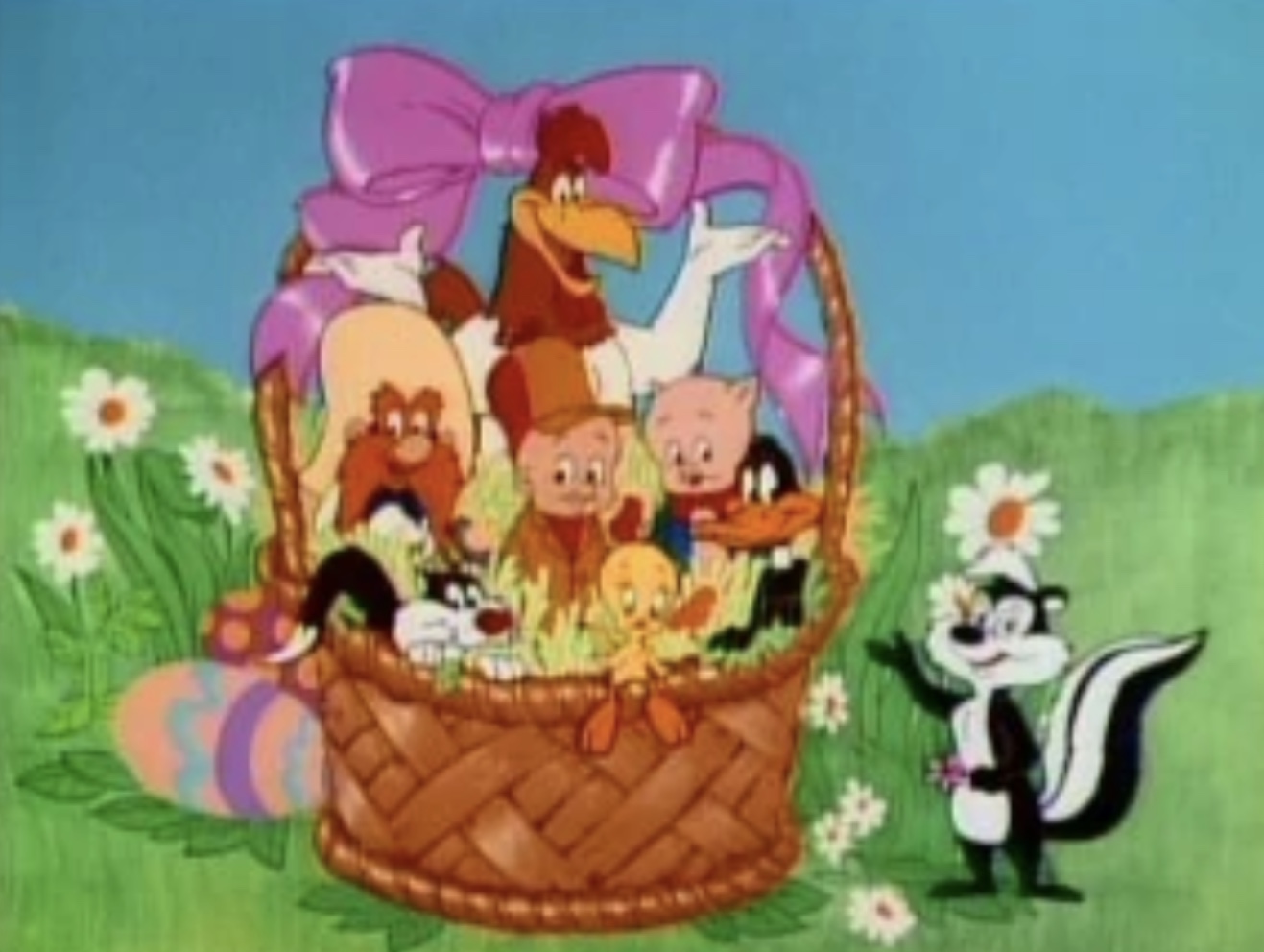
Also called Bugs Bunny's Easter Funnies, this special is about the Easter bunny feeling under the weather, and Granny knowing who would be the perfect substitute - Bugs Bunny!  She heads over to the Warner Bros. studio lot to find Bugs and encounters the Bunny and other members of the Looney Tunes canon busy making their movies.


Daffy Duck is eager to help but always winds up in the wrong outfit (such as an Easter basket).


The special is indicative of many Bugs Bunny specials from the decade, in which classic Waner Bros. cartoons are bridged with new animation (that doesn't always match or have a heck of a lot of continuity).


Ah well, we get to hear the wonderful vocal work of legends Mel Blanc and June Foray and watch scenes from some of the funniest cartoons ever made.


 A Family Circus Easter (originally aired April 8, 1982)


From a time when almost every newspaper comic strip was getting its own holiday special comes this animated adaptation of cartoonist Bil Keane's popular strip.


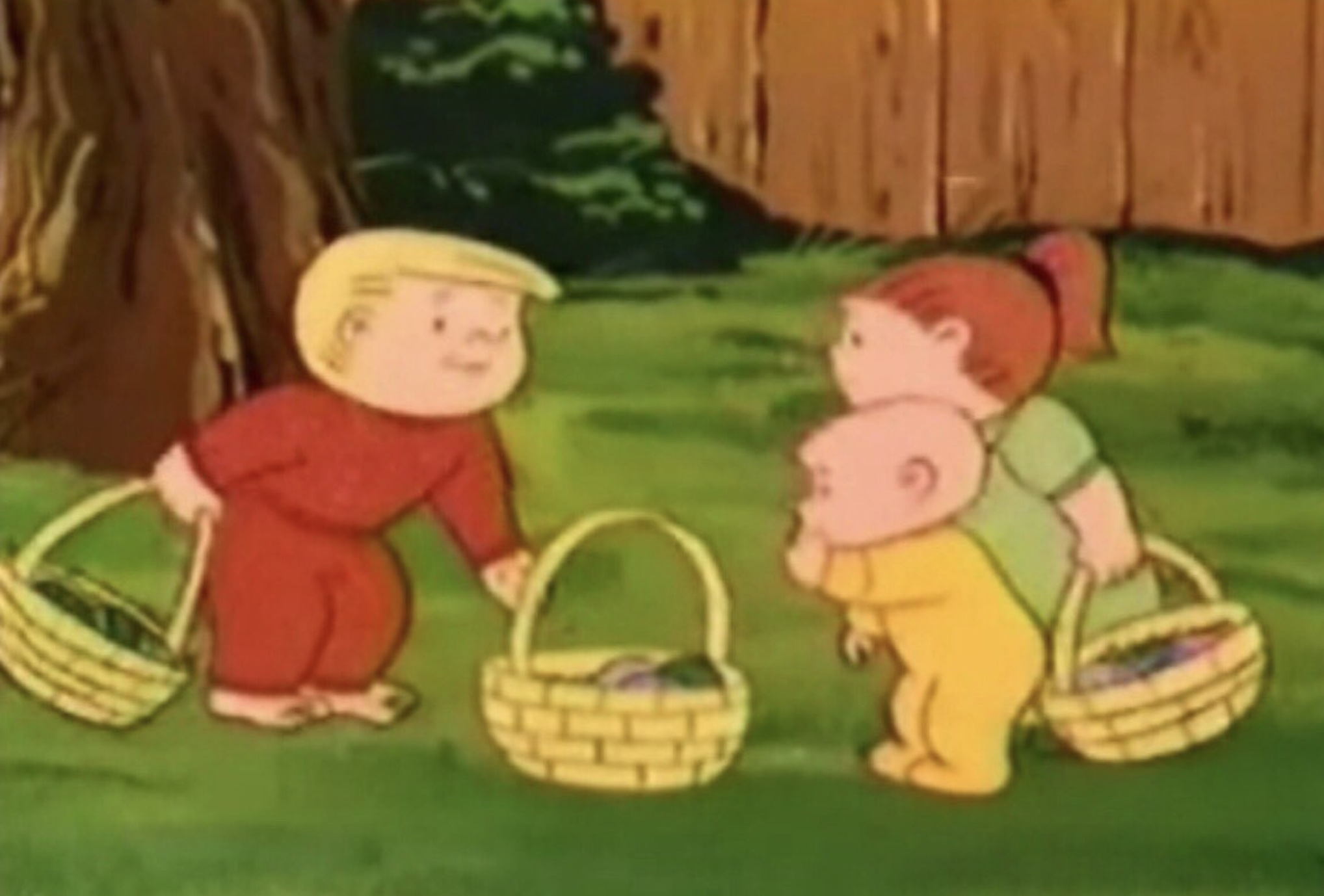
The special centers on the kids Jeffy, Dolly, Billy, and PJ on the night before Easter.  They're all concerned that their baby brother, PJ, won't be able to find any eggs during the hunt the following day.  With mom and dad asleep, the kids then sneak out in the middle of the night to hide the eggs and attempt to catch the Easter Bunny.


And that, essentially, is the special's entire plot (reflecting the comic strip's simple charm).  Unlike the comic strip, there is a moment of psychedelic and surreal animation.


The kids look through an Easter Egg viewer (like a kaleidoscope or view master) and see a colorful, magical Easter village, complete with the Easter Bunny (voiced by Dizzie Gillespie).  It includes a musical number that goes on too long and ethereal animation that seems entirely out of place with the rest of the special, but it's still fascinating to watch.


Each of these shows are great to look back on. They provide perfect Easter season viewing, and also give us a glimpse at a time when TV produced specials for seemingly every holiday, and we all waited for them eagerly in front of the television!


Happy Easter!


*My new book, Drawn to Greatness: Disney's Animation Renaissance is now available on Amazon, click here: Drawn to Greatness


**And, check out more of my writing on my website: Words From Lyons


Thursday, April 7, 2022

Pitch Perfect: The 70th Anniversary of "Singin' in the Rain"


By Michael Lyons


"Singin' in the Rain emanates joy." - Jeremy Arnold, The Essentials: 52 Must-See Movies and Why They Matter


This brief statement sums up this musical masterpiece perfectly.  Singin' in the Rain is one of the perfect films.  It is meticulously crafted with dance numbers that shine brighter than ever, music that has woven its way into our collective film fabric, sharp comedy, and an almost indescribable, cheerful glow from the first to last frame.


This movie is good for the spirit.


For anyone unfamiliar, Singing' in the Rain is set during an age when Hollywood was transitioning from silent films to "talkies."  Gene Kelly plays famous movie star Don Lockwood, who has to segue to this new age in the movie, with his recurring, on-screen co-star Lina Lamont (a hysterical Jean Hagan), who, unfortunately, has a voice that's a better fit for silent films.


Their attempt at a sound film is, at first, met with disaster until Don and his best friend and former dance partner, Cosmo Brown (Donald O'Connor in a hilarious, physical performance),  and love interest Kathy Selden (luminous Debbie Reynolds) come up with an idea to make the film a musical.


But will Lina agree to have Kathy as her substitute singing voice?


Directed by Kelly and Stanley Donen, Singin' in the Rain was conceived by MGM producer Arthur Freed as a way to use the studio's catalog of songs.  And, what songs they are!


Among them:


"Make 'Em Laugh," performed by O'Connor, ranks as one of the most staggering and gravity-defying dance routines in film history.  The dancer's ability to leap over furniture and through walls is filled with humor and talent that is just plain humbling, not to mention hysterical.


"Good Morning" isn't just incredible to watch as Kelly, Reynolds, and O'Connor dance with precision (in one, almost seemingly continuous shot), but the song has rightly become one of the world's most positive and feel-good tunes.


"Broadway Melody" is the epitome of the heyday of MGM musicals - bright, colorful, and filled with Kelly's astonishing dancing acrobatics.


Then, of course, the title song, "Singin' in the Rain."  One of the most iconic moments in music and film history, and with good reason. Not only is it beautiful dancing, but it's also beautiful filmmaking.  Plus, when Kelly starts the song with his "Doo-dee-doo" intro, you feel like you're about the be visited by an old friend as the torrential song and dance begins.


Released on March 27, 1952, at Radio City Music Hall in NY and then on April 11th everywhere, Singin' in the Rain marks its 70th anniversary this year.


Now is the time to revisit this amazing film, whether it's been too long since you've last seen it, or you've always wanted to watch it.  We could all use the "joy" that this movie provides.


As Gene Kelly declares during his most famous scene in Singin' in the Rain, after watching it, even time and time again, you will no doubt say:


"I'm Happy Again!"


*My new book, Drawn to Greatness: Disney's Animation Renaissance is now available on Amazon, click here: Drawn to Greatness


**And, check out more of my writing on my website: Words From Lyons


Thursday, March 24, 2022

Pushing the Envelope: Memorable Oscar Acceptance Speeches

Bob Hope (left) attempts to jokingly steal Marlon Brando's 
Best Actor Oscar for On the Waterfront.

By Michael Lyons

Cheers, jeers, and tears.  This has all happened at The Academy Awards.  The show has always brought the unexpected with it.

From emotional moments to kitschy dance numbers and political statements, there have been so many unforgettable moments on The Oscars telecast, but one thing has remained consistent: memorable acceptance speeches from the winners.

With the 94th Academy Awards scheduled for this weekend, it's the perfect time to reflect back on just some segments of the acceptance speeches we can't forget:


"I may have the baby right here!"

 - Eva Marie Saint (who was nine months pregnant at the time), Best Actress, On the Waterfront


"...it is a long journey to this moment..."

 - Sidney Poitier, Best Actor, Lillies of the Field


"I'll just say what's in my heart: Ba-Bump, Ba-Bump, Ba-Bump, Ba-Bump.

 - Mel Brooks, Best Original Screenplay, The Producers


Carmine (right) and Francis Ford Coppola


"I want to thank my son Francis Ford Coppola for being up here because without him I wouldn't be here. However, if I wasn't here he wouldn't be here either, right?"

 - Carmine Copolla, Original Dramatic Score, The Godfather II (1974) 


"Well, I guess this proves there are just as many nuts in the Academy as anywhere else."

 - Jack Nicholson, Best Actor, One Flew Over the Cuckoo's Nest (1975)


"...I can't deny the fact that you like me.  Right now, you like me!"

 - Sally Field, Best Actress, Places in the Heart (1984)


"I would like to thank anyone who ever punched or kissed me in my life and everybody who I ever punched or kissed."

 - John Patrick-Shanley, Best Original Screenplay, Moonstruck (1988)


"They forget, they forget to ask you to go out there and you...you do all these...things.  Like, for instance, you go out there and do these one-arm push-ups..."

 - Jack Palance (before leaving the podium to do one-arm push-ups on stage), Best Supporting Actor, City Slickers (1991)


"You broke my streak."

 - Al Pacino (who had been nominated eight times before winning), Best Actor, Scent of a Woman (1992)


"This moment is so much bigger than me.  This moment is for Dorothy Dandridge, Lena Horne, Diahann Carroll.  It's for the women who stand beside me, Jada Pinkett, Angela Bassett, Viveca Fox.  And, it's for every nameless, faceless woman of color that now has a chance because a door tonight has been opened."

 - Halle Berry, Best Actress, Monsters Ball (2001)


"Call your mom, call your dad.  If you're lucky enough to have a parent or two alive on this planet, call 'em.  Don't text.  Don't e-mail.  Call them on the phone.  Tell 'em you love 'em, and thank them, and listen to them for as long as they want to talk to you."

 - J.K. Simmons, Best Supporting Actor, Whiplash (2014)


And, we should thank these and other Oscar winners who have inspired us with their gratitude and have allowed us to dream our own dreams.

Happy Oscar Weekend!


*For more of my articles, visit my website, Words From Lyons: Words From Lyons

**And...my new book, Drawn to Greatness: Disney's Animation Renaissance is now available on Amazon!: Drawn to Greatness