Wednesday, November 24, 2021

Sale Away: Movies That Celebrate Black Friday and Holiday Shopping

By Michael Lyons


Black Friday sure has changed.  What started as a way for many to spend the day after Thanksgiving and kick off their Christmas shopping soared into crowd-infused cacophonies that began on Thanksgiving night, as soon as the last bite of turkey was finished and then segued to pre-Thanksgiving Black Friday sales and online shopping sprees. 


Black Friday is still a "thing" (in fact, there's a comedy-horror film entitled Black Friday that recently debuted). Whether you spend it online or on-a-line in a store, this year's upcoming retail-focused day is on its way.  


In honor of Black Friday, here are some movies that celebrate holiday shopping: 


Paul Blart: Mall Cop (2009)


THE Black Friday movie!  Kevin James is the titular character, a sad-sack mall security guard who takes his job seriously.  And it's a good thing he does, as he finds himself saving a mall from terrorists who take it over on Black Friday.


A comedic take on Die Hard, Paul Blart: Mall Cop is a very likable and funny film.  James makes the main character immensely sympathetic, and there's a pleasant immersion into the "mall culture" with the stores' various employees.


Blart's attempts at thwarting the terrorists provide some humorous jabs at action movie tropes (James displays excellent physical comedy in several scenes, particularly one where he tries to hide behind a pillar).


Paul Blart: Mall Cop is an enjoyable celebration of what's now a seemingly fading, yet comforting, world, the friendly neighborhood shopping mall.


Jingle All the Way
 (1996)


Here is a movie almost unanimously panned by critics and moderately ignored by audiences during its initial release but has become beloved through the years.


This holiday season marks the 25th anniversary of this Arnold Schwarzenegger comedy. He plays frantic dad Howard Langston, who goes to great, desperate lengths to find the action figure Turbo Man as a Christmas present for his son.


In the film, Turbo Man is that season's hottest gift, short-in-supply, and high-in-demand.  Jingle All The Way was inspired by the Cabbage Patch Doll craze of the '80s, and, ironically, the same season the film was released, Tickle Me Elmo was the "gotta have it" toy of Christmas time 1996.


Filled with frenetic family-friendly slapstick, which seemed to be a genre unto itself in the '90s, Jingle All The Way, is a not-so-subtle statement of holiday shopping mania that once filled stores regularly.


 Holiday Affair (1949)


Another, much different, look at Christmas shopping of another time.  A department store clerk named Steve Mason, played by Robert Mitchum, working in the toy department during the busy Christmas shopping season, sells a model train to a "secret shopper" from a rival store named Connie Ennis (Janet Leigh).  When she attempts to return it and Mason, trying to be friendly, allows her to, he breaks store policy and is unfortunately fired.


What follows is a romance that develops between the two, resulting in a love triangle with Connie's boyfriend (Wendell Corey), as Steve endears himself to widower Connie's son, Timmy (Gordon Gebert).


Providing a friendly, comforting glimpse at Christmas in post-War America (it's quaint to see what was considered a "bustling" department store), Holiday Affair is immensely likable.  It's so nice to see Robert Mitchum ake a break from his standard, "tough guy" roles of the time, and Janet Leigh has never been more charming.


With its romantic-comedy plot, set against the backdrop of Christmas, where everyone learns what's important, Holiday Affair plays out like the grandfather of today's Hallmark Christmas Movies.


 The Shop Around the Corner (1940)


Christmas movies don't get cozier than this one.  Set in Budapest, during the weeks leading up to Christmas, the film centers on two employees of a small shop, Alfred Kralik (James Stewart) and Klara Novak (Margaret Sullavan).  The two don't get along at all at work but are unknowing, anonymous romantic pen pals who are falling in love.


Not just an excellent Christmas movie (and, again, a look at Christmas shopping during another decade), The Shop Around the Corner is also considered one of the best romantic comedies ever made. 


 It's no wonder the film has been remade twice, first in 1949 as In the Good Old Summertime and then again in 1998 as You've Got Mail.


Left, 1947's original Miracle on 34th Street. Right: The 1955 made-for-TV movie.


Miracle on 34th Street


No matter what version of this Christmas perennial you prefer: the 1947 original, one of the made-for-TV versions from 1955, or 1973 (there was a 1959 TV version that's difficult to find), or the big-budget remade from 1994, there's no denying how this story captures the magic of the Christmas season.


Left to right, 1959 and 1973's made-for-TV versions of Miracle on 34th Street


The tale of the real St. Nick, working as a department store Santa Claus, says so much about the kindness and light that Santa brings to our world and how we should all try and do the same.


1994's remake of Miracle on 34th Street.


Watching one or all these films may allow you to take a break from your own Black Friday and Christmas shopping festivities.  Each, in their way, also shows just how hard employees in the retail industry work, particularly at this time of year and particularly during these challenging times.


They all deserve our thanks and respect for allowing us to be able to go shopping and find those cherished holiday gifts for family and friends.


Wishing them and wishing us all a happy and safe Black Friday and Christmas Season!


Sources:

Christmas at the Movies by Jeremy Arnold

IMDb

Wikipedia


Thursday, November 18, 2021

Thanksgiving Thieves: Looking Back at "Tower Heist"


By Michael Lyons

Tower Heist is a Thanksgiving movie.  That wasn't a typo.

As its title and its cast suggest, this is, first and foremost, a comedy/action/heist movie, but its setting makes it perfect viewing for this time of year.  It's been ten years since Tower Heist debuted and, if in the past decade, it's passed you by, the movie's 10th anniversary, and the Thanksgiving holiday, make it the perfect time to include it as part of your holiday movie rotation.

Set in New York City, Tower Heist is an ensemble film. Still, it centers on Josh Kovak (Ben Stiller doing a nice job as the everyman in the middle of the ensuing chaos) of the Tower, a luxury, high-rise apartment building.  One of the famous tenants is Arthur Shaw (Alan Alda in a nice slimeball turn), a Wall Street billionaire.

In the opening segments of the film, we meet the other employees and residents at The Tower.  Among them: Josh's brother-in-law Charlie (Casey Afleck), the concierge, Enrique (Michael Pena), the elevator operator, Odessa (Gabourey Sidibe), a maid in the building, Josh's boss, M. Simon (Judd Hirsch), Lester (Stephen McKinley Henderson) the doorman and Mr. Fitzhugh (Mathew Broderick), a Wall Street investor who is bankrupt and facing eviction. 

All the characters learn that Shaw has embezzled $2 billion and is placed under house arrest at The Tower by FBI Agent Claire Denhan (Téa Leoni).  What's worse, part of the money was the pensions of The Tower employees, which is now lost.

Enlisting the help of "Slide" (a very funny Eddie Murphy), a loud-mouth crook who lives in his Queens neighborhood, Josh pulls together an incredibly mismatched team of his fellow employees and the dejected Fitzhugh to steal their money back from Shaw's apartment.

So, what in the world does all of this have to do with Thanksgiving?  Well, the inept thieves make a plan to pull the heist on Thanksgiving Day, while the Macy's Thanksgiving Day Parade provides a distraction, passing right in front of The Tower.

Their "code phrase" is: "We go on Snoopy," meaning they initiate their plan as the Snoopy balloon in the parade passes.  

There are some wonderful scenes and recreations of the famed Macy's Parade in Tower Heist, as well as some lovely shots of autumn in New York.  The scenes of how they pull off the heist high above the streets, with the parade playing out down below, are some of the film's best and most exciting They're not the most realistic, but they are a tremendous amount of fun.

All of Tower Heist is fun, which is what it seems to set out to be.  The enjoyment comes from watching the disparate actors (and characters) bounce off each other.  Broderick's calm, dry persona, next to Murphy's brash tone, next to Pena's street smart, next to Stiller's exasperation, make for some hilarious scenes.  In particular, Murphy's scene as "Slide" teaching the others to pick a lock is filled with quick humor and one of the film's funniest sequences.

All of this is pulled together deftly by director Brett Ratner, who balances the various characters and shifting action well.  If there's any disappointment, the ending of Tower Heist seems somewhat abrupt (check out the deleted/alternate endings, where available, they're a little more satisfying). Still, it doesn't take away from all of the entertainment that's come before.

Tower Heist plays out like an enjoyable amalgam of movies from another time: the all-star studio films of the '60s and '70s blended with the action comedies that were a staple of the '80s.

And, it's a Thanksgiving movie.  So, if you're looking for something entertaining to watch for the holiday, just remember: "We go on Snoopy."


Happy Thanksgiving, everyone!


Thursday, November 4, 2021

A Whale of a Tale: The 35th Anniversary of "Star Trek IV: The Voyage Home"


By Michael Lyons

Movies don't get more entertaining than Star Trek IV: The Voyage Home.  The film feels like a joyful reunion for its cast, but it's also a triumph for fans, or casual fans, and a delightful 122 minutes for audience members who are neither.

Looking back on the film as it celebrates its 35th anniversary this month, it's also interesting to see just how groundbreaking Star Trek IV was, in its use of humor, its relatable science fiction plot, and its eco-friendly theme.

Picking up where 1983's Star Trek III: The Search for Spock left off, Star Trek IV brings back the entire, beloved Enterprise crew: Admiral Kirk (William Shatner), Mr. Spock (Leonard Nimoy), Dr. McCoy (DeForest Kelley), Mr. Scott (James Doohan), Mr. Sulu (George Takei), Uhura (Nichelle Nichols) and Commander Chekov (Walter Koenig).

The crew is heading back home to Earth to face trial for their actions in the previous film, where they had rescued Mr. Spock (who is still not quite his usual Vulcan self, as he recovers from a resurrection).

As they head back to Earth, they pick up a distress call from Starfleet Command.  It seems a strange signal from a large, cylindrical object hovering above Earth is wreaking havoc with its emitting signal.

Spock determines that the call is that of a humpback whale, and only the return of this call can stop the odd object from its destruction.  The only problem is that, in 2286, humpback whales are extinct.

Kirk and the Enterprise team devise a plan: travel back in time to 1986, find a humpback whale and bring it to, well, "back to the future."

And so, as The Enterprise crew (on board a Klingon ship they've hijacked) arrives in the San Francisco of 1986.  The fish-out-of-water fun begins as they try to blend in while searching for the massive mammal in our modern world.

 This is where Star Trek IV overflows with more humor than any other entry in the Star Trek movie franchise, as the crew from the future tries to assimilate to our current (or at least '80s) world.

A majority of this comes from the interaction and banter between Shatner and Nimoy, as Kirk and Spock.  They head to a local aquarium and befriend a marine biologist (Catherine Hicks) in their quest to find humpback whales.

Kirk and Spock bicker like an old married couple, and a scene in which Kirk tries to cover for Spock's inability to lie is filled with impeccable comic timing.  There's another scene where Spock jumps into a tank, to "mind-meld" with one of the whales, that brims with brilliant physical comedy.

The rest of the cast has their moments, as well.  Among the best (and funniest) is Kelley as Bones railing about how "medieval" our "modern medicine"  is, and another, where Doohan as Mr. Scott attempts to operate a computer.

Leonard Nimoy directed Star Trek IV (his second time at the helm for series after Star Trek III), and he displays such a deft, cinematic flair, especially with the comedy scenes.  It's no wonder he scored a hit the following year with Three Men and a Baby.

 Star Trek IV debuted over Thanksgiving weekend, opening on November 26, 1986, to great acclaim, eventually grossing $133 million worldwide.

Thirty-five years later, what makes Star Trek IV stand out against the other films in its franchise is that it doesn't have a significant focus on starships and laser-infused dogfights, but instead a more human, down-to-earth story (literally).

With its whale-centric plot, the film also has a still-relevant message about the state of our world.  "To hunt a species to extinction is not logical," observes Spock about the whales.

Film critic Roger Ebert summed up Star Trek IV: The Voyage Home perfectly in his 1986 review when he called it "...the most elegant and satisfying Star Trek film so far."

Sources:

IMDb

Rogerebert.com


Thursday, October 28, 2021

Taking Another Stab at It: The 40th Anniversary of "Halloween II"


By Michael Lyons

Oh, Michael Myers, look what you started!

With the knife-wielding madman's first appearance in director John Carpenter's seminal horror film, Halloween in 1978, the man in the William Shatner mask changed movies forever, opening up a new genre: the slasher film.

Jason in Friday the 13th, Freddy Kreuger in A Nightmare on Elm Street, Ghostface in Scream, and countless others followed.  The success of these films, one after another, allowed Hollywood studios to see just how much audiences loved them, as well as just how lucrative that "jump scares" in theaters could be.

Another "game changer" came three years after the original Halloween with the aptly titled Halloween II sequel.  It was another success, grossing over $7 million in its first weekend when it opened on October 30, 1981.

Suddenly, new doors were sliced open, and the slasher film became a "franchise," with studios suddenly realizing that as long as the killer could continue to "rise from the dead" at the end of each film, a subsequent sequel could...and would...follow.

Halloween II was the first continuation of a story that emerged as a series of films that continues to be popular over four decades later.

Other sequels and remakes have followed, some following different Michael Myers' "timelines" than others, but all of them quenching a "bloodthirst" that fans have for the Halloween films.  The latest installment, Halloween Kills, opened to an impressive $90 million worldwide after debuting October 15 in theaters and the Peacock streaming service.

The original Halloween II (there was another same-titled sequel in 2009 by director Rob Zombie) celebrates its 40th anniversary this fall. With all the focus on both Halloween, the season, and the movies, it's an appropriate time to look back on the sequel that started it all.

Director Carpenter elected not to return for the follow-up to his groundbreaking original.  Instead, he opted to co-write it with Debra Hill and turn the directing reigns over to Rick Rosenthal.

Halloween II picks up right where the original left off. We see Dr. Loomis (Donald Pleasance) shoot Michael after he attacks Laurie Strode (Jamie Lee Curtis).  Michael falls off the second story of the house but disappears mysteriously into the small town of Haddonfield.

Laurie is taken to the hospital, and Dr. Loomis joins the Sheriff (Charles Cyphers) to track down Michael, who continues to terrorize the citizens of Haddonfield, but then makes his way to the hospital to find Laurie.

Halloween II suffers, as many sequels do, from the fact that it's not the original.  What was novel and shocking about the first is expected here.  Still, there is much to enjoy from this entry, particularly if you're already a fan of the franchise.

Director Rosenthal upholds the continuity well from the original, effectively using "point of view" camera work in several scenes and finding creative ways to bring Michael, a/k/a "The Shape," into scenes with a jolt.  

Most of Halloween II takes place in the hospital, used to creepy, claustrophobic effect. There are well-choreographed scenes in darkened hallways and chilling shots captured on security cameras of Michael walking the grounds. 

Michael also employs new and inventive methods for his "kills" - everything from injection needles to Jacuzzis are employed. 

A "twist" in the story has drawn the ire of fans through the years; apparently, even Carpenter himself wasn't happy with it.  Many say that this is what led to later sequels and different timelines in the Halloween franchise.

 The second Halloween still gets its love, particularly from many devotees and especially this time of year.  

Now, four decades later, with so many similar films come and gone, 1981's Halloween II not only proves itself to be a perfect example from a time that can best be dubbed "the golden age of slasher films."  And now, watching it is a nostalgic, seasonally-appropriate favorite.

 Oh, Michael Myers, look what you started!


Happy Halloween, Everyone!


Sources:

IMDb

Wikipedia


Thursday, October 21, 2021

Smashing Pumpkins: "Home Improvement's" Halloween Episodes

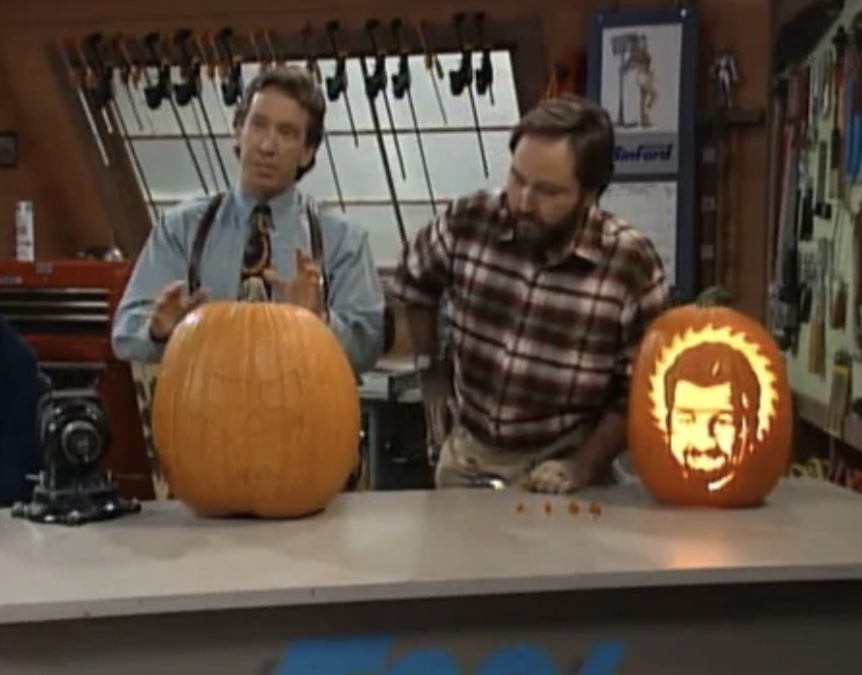
Tim (Tim Allen) and Al (Richard Karn) with
a Bob Villa inspired Jack O' Lantern on
Home Improvement's first Halloween episode


 By Michael Lyons


"More Power!" became the rallying cry for many when the hit sitcom Home Improvement debuted thirty years ago this fall.  Not only did the show make a star out of comedian Tim Allen and become a staple of 90s television, but in its second season, Home Improvement started a tradition of creating a new Halloween episode each year for eight seasons.


The series revolved around Tim "The Tool Man" Taylor (Tim Allen), the host of a popular home improvement show "Tool Time" (inspired by Bob Villa's real show "This Old House") and the trials and tribulations of his family, wife Jill (Patricia Richardson), and sons, Brad, Randy, and Mark (Zachery Ty Bryan, Jonathan Taylor Thomas, and Taran Noah Smith).


The ongoing joke of the show is that even though Tim is "The Tool Man," he is all thumbs when it comes to anything related to improving the home.  His repairs and "fix its" usually had disastrous results. His co-host on the show was Al Borland (Richard Karn), who has the handiest skills, and neighbor Wilson (Earl Hindman, an enigmatic figure, partially obscured in each episode by the backyard fence) provides wisdom.


The annual Halloween episodes of Home Improvement were so popular with viewers that they became expectations each year while the show was airing on ABC.  In honor of Home Improvement's 30th anniversary and "spooky season," here's a look back at all of the Taylor family's Halloween celebrations.


"Haunting of Taylor House" (1992)


Home Improvement's very first Halloween episode begins in typical Tim Taylor fashion, as he uses "more power" to carve a Jack O' Lantern and splatters Al with "pumpkin guts."


The Taylor's ready the house at home for their son Brad's Halloween party, where Tim has built a haunted house in the basement dubbed the "Catacomb of Terror."


Some adolescent angst between Brad and his girlfriend drives the plot, but the show never forgets it's celebrating Halloween.  The episode goes all in, with every square inch of the Taylor house decked out, the basement "Catacomb of Terror" looking as impressive as a theme park attraction, and Tim dressed as a zombie grandma named "Nanastein."


All of this, coupled with the show's usual well-timed jokes, makes this Home Improvement episode pure, wall-to-wall Halloween fun.  It's no wonder it became a tradition for the Taylor's and viewers.


"Crazy for You" (1993)


In the series' second Halloween episode, Tim becomes convinced that a "Tool Time" viewer named Rose is stalking him.  Is she, or is this a well-planned Halloween prank?


It's fun to see the prank tables turned on Tim in this episode and even more fun to see the producers "one-up" the Halloween theme.  Tim wears an impressively detailed zombie costume and Wilson, hidden behind the Phantom of the Opera mask, are impressively humorous and creative.


"Borland Ambition" (1994)


This episode features Halloween somewhat in the background, as the plot revolves around Al becoming obsessed with a hardware store he has purchased.  But, when Halloween does surface in the show, it does so in perfect, Home Improvement style, particularly a gag where the youngest member of the Taylor clan, Mark, dresses as Al to go trick or treating.


"Let Them Eat Cake" (1995)


Halloween provides the backdrop again for this episode.  It centers on Tim and Jill going to a cable award show on Halloween night, with Brad throwing a party while they're out, against their parents' wishes, as Mark is home sick with an earache. 


When "Tool Time" continually loses at the awards to a cooking show, Al decides to change into his costume and leave early for a Halloween party.  Of course, their show wins the big award, and Al must deliver his acceptance speech dressed as a mouse.


"I Was a Teenage Taylor" (1996)


A tangled web of Halloween pranks consumes Tim, Jill, Al, and the Taylor boys in this creatively funny episode that keeps you guessing.  Best of all, with this, Home Improvement returns to Halloween taking center stage for the plot.


The final prank on older brothers Brad and Randy is filled with fun costumes and creepy effects.  As the Taylor's friend Larry says, "In all my years, I've never seen a family go to such sick lengths to torture each other on Halloween!"


"A Night to Dismember" (1997)


Another fully Halloween-infused episode begins with Tim and Al dedicating "Tool Time" to "pumpkin racing," where they race Jack-O'-Lanterns on wheels around a small track.


From there, the show centers on Mark and his friend making a student horror film, which raises concerns from Jill, as she feels it reflects what he thinks about his family.  He asks his family to act in the movie, which leads to some great, cynical comments from Tim, mainly as he and Jill try to support their son, the movie director, no matter how gruesome his film may be.


"You want to help?" asks Mark.  "Let me chop off your heads."

"Okay!" answers Tim with a sarcastic smile.


"Bewitched" (1998)


The last season brings the usual array of Tim Taylor pranks in what may be one of the best Halloween episodes.  An excellent opening gag involves Jill pretending to be scared by Tim's pranks, as she has gotten so used to them.


The "Tool Time" episode features a detailed, tongue-in-cheek look at "How to design the perfect torture chamber."


Neighbor Wilson has a Halloween party and introduces the Taylors to his new girlfriend, who claims to be a real witch.  After Tim buts in and talks Wilson into breaking up with her, Wilson disappears...or is it just another elaborate Halloween prank?  Well, how else would Home Improvement celebrate their last Halloween?


Scares, costumes, creatures, trick-or-treaters, and exploding, flaming pumpkins all served up with some comforting, retro family-friendly laughs.  A marathon of some or all these episodes from the eight seasons of Home Improvement could most definitely give your Halloween "More Power!"


Sources:


bloody-disgusting.com

IMDb


Thursday, October 7, 2021

A Knife Time Was Had By All: The 25th Anniversary of "Scream"


By Michael Lyons

"What's your favorite scary movie?"


This, now iconic line of dialogue, has become somewhat ironic for the film that coined the phrase.

That's because, twenty-five years after it was first uttered, one of the answers to the question could be the movie that gave us the famous phrase itself, Scream.


Penned by writer Kevin Williamson and directed by horror movie maestro Wes Craven, Scream turned the horror movie genre and the movie industry upside down and sent executives screaming down the hallways of Hollywood studios in attempts to duplicate the film's success.


Before the word "meta" was a thing, Williamson (a struggling screenwriter at the time) took a familiar story of teenagers stalked by a knife-wielding killer.  However, he set it against a world where the teenagers involved were familiar with the tropes found in some of the most famous "slasher movies," bringing up the familiar scenes found in such films. In contrast, a killer bears down on them in their town.


We hurtle into the film with a now-famous and chilling opening sequence.  A teenager named Casey (Drew Barrymore, in an extended cameo) is home alone and tormented, first by phone and then in-person, by a figure clad in a black robe with a terrifying mask that resembles the famous painting "The Scream" by Edward Munch.


The killer (eventually referred to as “Ghostface”) goes on to terrorize the town, especially high schooler Sidney Prescott (played well with tortured empathy by Neve Campbell).


And as students and residents get "offed" one-by-one by the mysterious masked murderer, what Sidney and the audience learns is that, in the words of the film's video store nerd, Randy (Jamie Kennedy, as great comic relief) is that "Everybody is a suspect!"


The killer could be Sidney's boyfriend, Billy (Skeet Ulrich), or his best friend, Stu (Matthew Lillard), or intrepid news reporter Gale Weathers (Courtney Cox), or seemingly innocent Sheriff Dewey Riley (David Arquette), among others.


Throughout its twists, turns, and "red herrings," Scream smartly keeps the audience guessing and guessing incorrectly (at least during a first viewing) until the film's final revelation of who the killer is.

While this is going on, there are many references to the past slasher movie blockbusters that paved the way for Scream.  This starts right from the film's gripping opening, during which "Ghostface" (the terrific, tense voice of voice actor Roger L. Jackson) quizzes Casey over the phone about famous horror movies. 


The genre then goes on to serve as the backdrop for the remainder of the film, with tropes - such as characters saying "I'll be right back," only to be killed and the killer, thought to be dead - rising up one last time, are called out as events happen in the film.


There's an exceptionally entertaining scene in which Randy lays on the couch watching John Carpenter's classic Halloween while the killer stalks him from behind.


The best part is that Scream uses all of this, not entirely for laughs, but also to significant, horrific effect.  Craven, a true master of his craft, brought tens,e audience squirming scenes effectively to life.  A sequence in which Sidney is trapped in a car while the killer lurks outside is brilliantly executed.


Scream, released on December 20, 1996, generated tremendous word-of-mouth success, grossing $173 million at the worldwide box office.


Three sequels, parody movies, and a TV series followed.  A fifth sequel is slated for release next year.  'Ghostface" has also made appearances on countless peices of merchandise, and, especially during our current Halloween season, the costume is still a favorite.


Twenty-five years later, Scream has emerged, not just as perfect viewing as we approach Halloween, it's also left an indelible, horrific "slash" into our movie pop-culture consciousness.


And, if anyone needs proof of that, just simply say, "What's your favorite scary movie?"


Tuesday, September 28, 2021

Magic Show: "The Grand Opening of Walt Disney World" Television Special

A 1971 TV Guide ad for The Grand Opening of
Walt Disney World TV Special.

By Michael Lyons

On September 30, 1971, The New York Times reported: "Disney World opens tomorrow, and the atmosphere among Florida business interests is as thick with tension as a Cape Kennedy countdown."

The Walt Disney World Resort would open on the next day, October 1, 1971, and was rightfully a big deal. When Walt opened Disneyland in California in 1955, he and his company changed entertainment and vacations forever.  Now, in 1971, just five years after Mr. Disney's passing, a second, new Disney theme park was about to debut in Florida, satisfying a need for another half of a country, during a time when air travel wasn't the seemingly commuter-like regularity of our lives that it is today.

And with this big deal came the need to promote the new Resort on television, a medium that Walt Disney had used brilliantly in the 1950s, to let everyone know about Disneyland.  The same would be done for this new Disney realm.

On October 29, 1971, NBC aired the 90-minute special, The Grand Opening of Walt Disney World, which featured an array of stars, introducing audiences to "The Vacation Kingdom of the World."  Watching it today, it is a fascinating historical document of Walt Disney World in its nascent days and the excitement around the opening of the Resort that's become a vacation tradition and ritual for so many.

As Walt Disney World celebrates its 50th anniversary this week, it's the ideal time to look back on the Grand Opening TV special and how it is now a time capsule of the Resort's innocent, early days.

The show opens with 70s icon Glen Campbell strolling through untouched Disney property, strumming his guitar, and singing the song "Today is Mine," when he happens upon the Walt Disney World monorail soaring by, high above him.

And, in the monorail?  None other than Julie Andrews (the beloved star, connected forever to Disney, thanks to her star-making turn as Mary Poppins).  She welcomes all of us at home to the special, as stunning ariel shots of the Resort are shown.

Ms. Andrews opens the special in a well, "practically perfect" way, performing a lovely medley of Disney anthems, "When You Wish Upon a Star," and "Zip-A-Dee-Doo-Dah," as she makes her way through The Magic Kingdom (while the park is open and very fortunate guests get to watch!).  Additionally, backup dancers in some oh-so-70s costumes and colors join in.

Julie Andrews performing at The Magic Kingdom

Some of the other segments include Bob Hope arriving at the then-new Contemporary Resort, where he does some of his trademark monologuing (introducing himself as "Bob ex-Mouseketeer Hope").  The legendary comedian also returns later in the special to deliver a heartfelt tribute to Walt Disney.

Bob Hope monologuing at Disney's Contemporary Resort


Jonathan Winters plays a variety of characters vacationing at Disney's Fort Wilderness Campground Resort, in which he does some of the most off-the-cuff and off-the-wall improvisations you've ever seen.

Comedian Buddy Hackett, who appeared in Disney's The Love Bug, joins "Herbie" the Volkswagon at the Speedway attraction for some shtick.

Throughout the special, there are also glimpses of such attractions as The Country Bear Jamboree, and It's a Small World, no doubt whetting the appetite of eager kids watching at home, who would soon be begging their parents to change their next vacation plans to Florida.

In a taste of "what once was," the show also provides a look at, now defunct, Walt Disney World attractions, such as The Skyway and The Mickey Mouse Review.

In a glimpse into another time, we see the original parade along Main Street, USA, and how much the characters who appear in the park have changed (you've gotta love those groovy, "Day-Glo" Aristocats).

The Grand Opening special culminates in an emotional moment as a tremendous chorus, and marching band, surround Cinderella Castle performing "When You Wish Upon a Star," as balloons are released and flood the sky.

In the fifty years since Walt Disney World opened and this special aired, the Resort, like the world itself, has grown and changed immensely.  It's been featured innumerable times after on television, from the opening of its other three theme parks, Epcot, Disney’s Hollywood Studios, and Disney’s Animal Kingdom to the backdrop for many shows, including Full House and Black-ish.

 With countless pop-culture and personal memories connected to Walt Disney World, one can't help reflecting on the words of Bob Hope in The Grand Opening of Walt Disney World Special:

"The entire world owes Walt Disney a great debt.  He achieved much, but perhaps his greatest accomplishment is that he made children of us all."

The finale of the Grand Opening special


Sources:


Nordheimer, Jon "New Florida Countdown: Disney World is Opening," The New York Times, September 30, 1971, p.26.


YouTube